
Step 10: The Design and Installation of the Irrigation System
Key Points
Satellite and decoder irrigation systems were commonly installed up to 20-years ago and are still found on many golf courses around the world. We’ll describe and contrast those outdated technologies against today’s most advanced irrigation systems.
The higher efficiency of newer irrigation systems can lead to significantly lower water and electricity costs over the lifetime of the system. We’ll discuss how the irrigation design consultant weighs the capital cost of the new irrigation system against the system’s anticipated lifespan and long-term operational expenses.
The irrigation main line is installed after site clearing and bulk earthwork. The irrigation laterals and rotors are installed after rough grading and at the same time as the installation of subsurface drainage. We will discuss potential conflicts and the best ways to coordinate the installation of the irrigation and subsurface drainage systems.
Cultural practices, such as deficit irrigation and irrigating primarily at night can also reduce chemical inputs and save time while positively impacting the health of the turf.
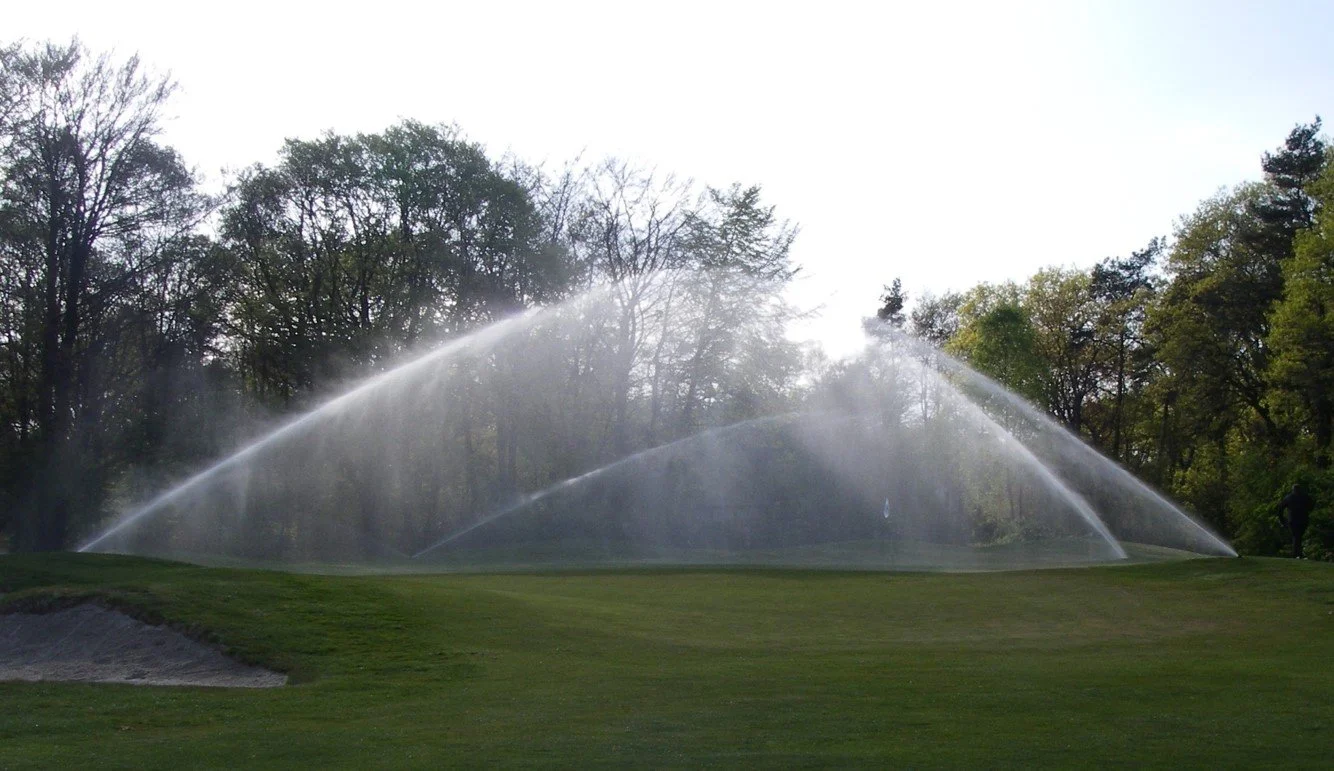
As we discussed in Step 4: The Role of an Irrigation Design Consultant, it’s good practice for the client to hire an irrigation design consultant toward the end of the design process to work alongside the golf course architect. This article will take a closer look at where there might be opportunities for greater efficiency and flexibility in the design of the irrigation system. Also, we will discuss the installation of the irrigation system and how it fits in with the other activities happening concurrently on the construction site.
Understanding Satellite and Decoder Systems - Outdated But Still Commonly Found on Older Golf Courses
While satellite and decoder systems are outdated relative to the latest irrigation technology, these systems are still found on many golf courses around the world so it’s good to at least understand the terminology and differences between them.
At the most basic level, an irrigation system is a means to deliver pressurized water from a water source to a system of valves (or solenoids), which can be turned on and off as needed by a central, a local, or a hand-held control system interface. Once a valve has been opened, the radius, trajectory, and distance that the pressurized water is broadcast is dictated by the irrigation rotor (whether full or part-circle) and nozzle (with adjustable trajectory and throw).
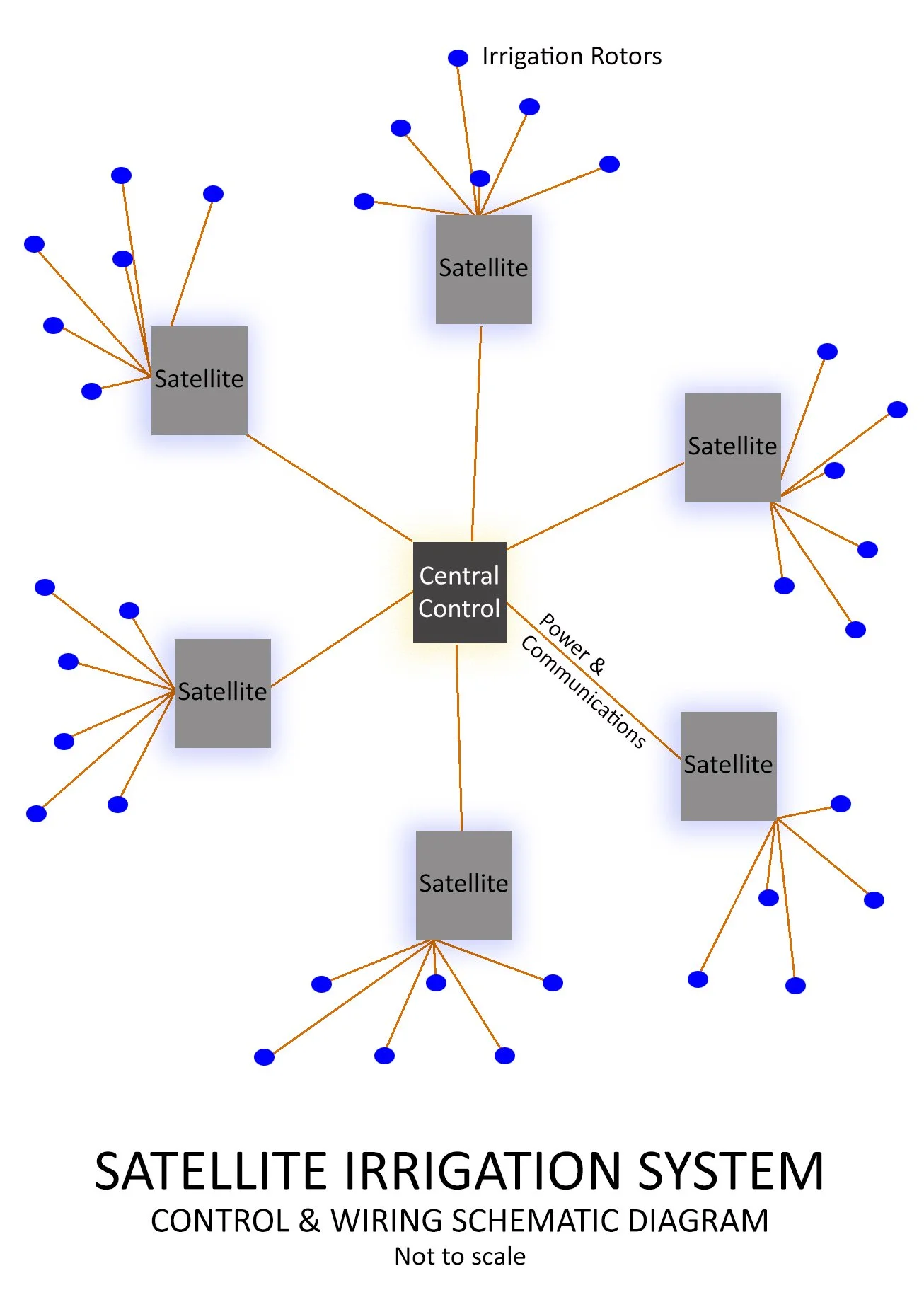
Up until around 20-years ago, either a satellite irrigation system or a decoder irrigation system would have been installed on a new golf course. Satellite systems were much more common in the United States, while golf course operators in Europe and Asia tended to favor decoder systems. The biggest difference between a satellite and a decoder system is how each individual valve is controlled. While both systems are controlled from a central control system on a personal computer at the maintenance facility - which gives the superintendent the ability to control and schedule each individual pump and rotor - a satellite system also has field controllers (or satellites) throughout the golf course, which are waist-high metal boxes that are mounted on concrete footings. These satellites serve as secondary power and communications hubs for the valves of 50 or more individual rotors. Decoder systems do not incorporate these additional field controllers.
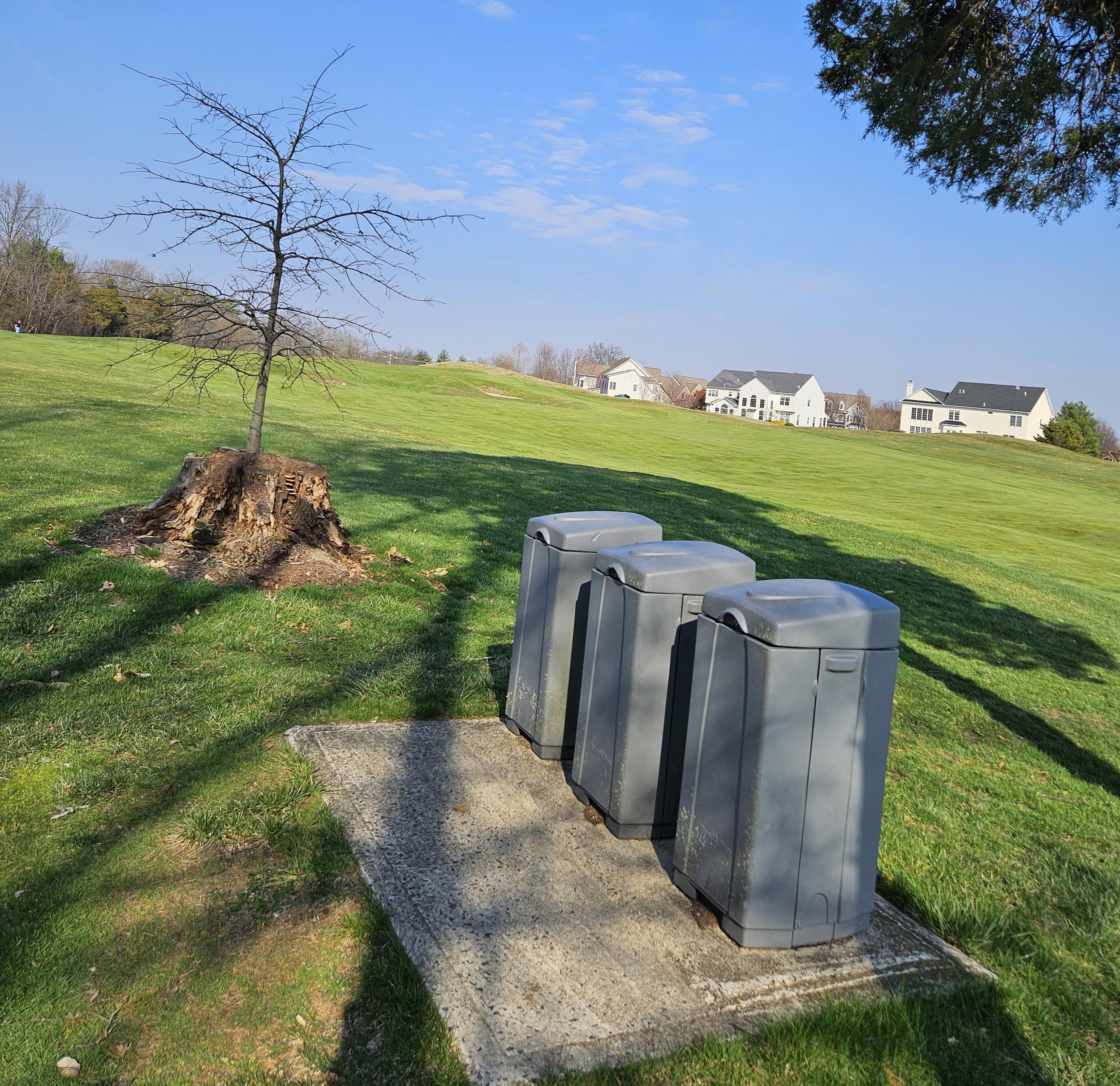
Irrigation “satellite” control boxes.
The satellite is connected by high voltage copper wire to each individual rotor within its hub and can execute schedules and also operate independently of the central control system. If new rotors are added, they would need to be (high voltage) wired to the nearest satellite with available capacity.
The main disadvantage of a satellite system is the amount of high voltage copper wire (power & communications) and conduit that is required to connect all of the rotors back to the satellites, which are each connected by the same high voltage copper wire back to the central control system. This wire and conduit are costly and labor intensive to install. Also, the satellite boxes, being above ground, tend to be unsightly and prone to vandalism or flooding. Finally, expansion or significant revision to the irrigation system is complicated by the need to (high voltage) wire any added rotor back to a nearby satellite that has capacity.
However, the main advantage of a satellite system is that, if the central control system at the maintenance facility were ever to be knocked off-line, the irrigation rotors would still be operational because each individual satellite would still be able to power and control the rotors connected to it. Secondly, satellites are individually grounded, which means that the individual irrigation rotors are protected from damage by lightning strikes.
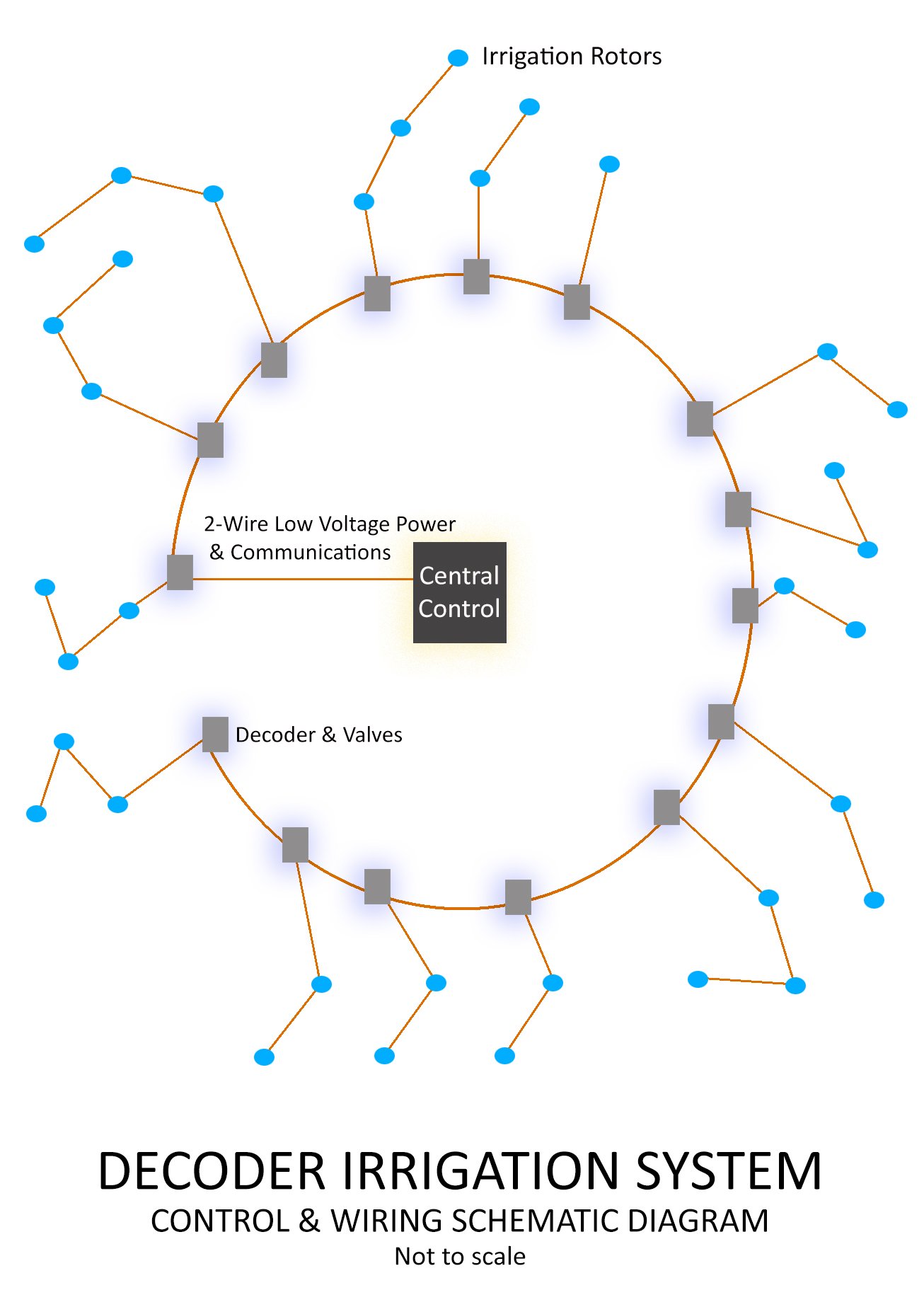
In contrast, decoder systems use micro-processor-controlled switches, which are buried within waterproof encapsulated containers (the size of a small can of cola) to control groups of rotors. The decoder receives signals from the central control system via low-voltage power and control wire, telling it to open and close the valves (solenoids) of the rotors that are connected to it.
A decoder-controlled irrigation system can have many thousands of decoders connected by two low-voltage wires that supply power and communications.
Like satellites, decoders are controlled from the central control system. If new irrigation rotors need to be added, an additional decoder simply needs to be spliced into the two-wire low-voltage line running back to the central control system.
The main advantages of the decoder system are:
No high-voltage power is required in the field;
Very easily expanded (within the capacity of the cable and decoder numbers), usually up to 250 decoders per cable path;
No above ground, unsightly satellite boxes;
The micro-processors are in waterproof containers, so can be used in areas of high flood risk.
Disadvantages
Difficult to troubleshoot if there is a problem with a rotor or a group of rotors. Needs a trained technician because the switching signals are encoded within the two-core low voltage cables, making it hard to identify where exactly a problem might be;
A decoder system requires four cable splices for a single decoder / solenoid coil connection. Therefore, there are potential problems at each splice;
If the central control system goes down for any reason, the entire irrigation system is inoperable.
Also, it is prohibitively expensive to ground each decoder so manufacturers recommended adding surge protection at a set interval. Therefore, a number of decoders are usually protected by a single surge device to confine the surge damage to a specific area – meaning many decoders in an area can still be damaged at one time by a lightning strike.
The selection of a satellite or decoder irrigation system was often based in part on the number of irrigation heads in the design and the size of the site, since there was a balance point between the higher cost of the decoder micro-processors and the higher cost of the satellite wiring plus the labor to install it. The amount of lightning that is common for an area, the aesthetics of the satellite boxes, and the ability of the turf to withstand a full system outage for a short period of time also factored into the decision.
Irrigation Systems Today
Though many existing golf courses still have satellite or decoder systems, the high cost of copper wire and advances in micro-processor technology mean that they are no longer viable or available for a new installation. Rather, modern irrigation systems utilize some aspects of both the satellite and decoder systems.
The biggest advance with the decoder unit micro-processors is that they now allow real-time, two-way communication between each decoder unit and the central control system. The wire that connects each decoder unit is still low-voltage but now requires only two splices instead of four, halving the effort and potential problems during installation. In addition, there is more capacity in the system, allowing up to 3x the number of decoder units per cable path, up to 750.
The real-time, two-way communication capabilities allow modern decoder units to self-diagnose problems in individual rotors and valves, making it much quicker and easier to identify and correct issues. In addition, the two-way communication allows each decoder unit to report field condition measurements (such as precipitation, moisture, temperature, and wind speed) back to central control in real-time. Central control software is now sophisticated enough to analyze this information and recommend real-time adjustments of the irrigation program to the irrigation manager/superintendent, or it can make instantaneous adjustments all by itself. Rain cans, anemometers (wind gauges), water supply pumps, transfer pumps, lighting, and security gates can all be incorporated into the central control system and operated remotely by the manager to better optimize the irrigation system and the management of the golf course.
Some other recent advances:
It is now faster and easier to change nozzles in individual rotors. Also, a variety of nozzles can now be incorporated into one rotor, allowing the superintendent the flexibility to irrigate at different ranges (long, medium, short) or trajectories (low or high) as needed and without requiring a lot of time or effort to make the change;
It is now faster and easier to change between a full and a part-circle throw pattern on an individual rotor;
Hand-held and wireless technology now allows the superintendent to get real-time moisture and temperature data from any irrigation rotor. The superintendent can control individual rotors from anywhere with internet access, on-site or off;
Central control systems (using the information supplied by atmospheric monitoring devices) are designed to optimize both turf health and water and power conservation and will recommend or initiate irrigation programs that do this.
There are minor differences between the irrigation systems sold by the largest manufacturers, but all of today’s irrigation systems are more flexible, more integrated with atmospheric monitoring devices, easier to troubleshoot, easier and quicker to maintain, and can be comprehensively controlled from just about any device with internet access.
Designing the Most Efficient Irrigation System
New irrigation systems collect and analyze a wealth of information in real-time and use ever more precise rotors and nozzles to greatly reduce wasted water (through overspray or leakage) and electricity. Over the lifetime of an irrigation system this should add up to significantly lower water and electricity costs. For a golf course renovation, the irrigation design consultant will carefully weigh the capital cost of a new or upgraded system and its components against the system’s anticipated lifespan and long-term operational expenses to decide what system and components are right for the job.
Some common measurements of efficiency are:
Uniformity – the irrigation rotors should be arranged so that all of the irrigated turf is getting enough, but not too much, water and the water being applied onto areas designated as “non-irrigated” (also known as overspray) is minimized. This often means more rotors, which will initially be more expensive, but the additional cost will eventually be recouped with water and power savings. Target 80% or better Distribution Uniformity (DU).
Wind drift can affect uniformity. Persistently windy sites will sometimes require lower trajectory nozzles with a smaller radius of throw, necessitating more rotors to achieve the same uniform coverage.
Run-off – when the precipitation rate from the irrigation system is greater than the infiltration rate of the ground, there is run-off, which, at best, is wasted water. At worst, it could lead to erosion or the transport of fertilizer, herbicides, or pesticides to unintended areas or off-site. The consulting agronomist can help to determine infiltration rates around the golf course and use this information to program the irrigation schedule to minimize run-off. Moisture sensors at each rotor can also ensure that no area is being irrigated unnecessarily.
Some common methods and technologies to increase irrigation system efficiency are:
Weather stations will measure current atmospheric conditions and communicate with the central control system to adjust the global irrigation schedule accordingly. Weather stations are typically solar powered and wireless so they can be placed in a remote part of the site without having to install electrical or communication wire.
Rain Cans can be placed throughout the golf course and will catch and measure the rain that has fallen, alert the central control system to the rain event and pause the irrigation system in real-time. The central control system can then deduct the depth of the precipitation from the irrigation program, saving water and energy (and making the superintendent look good by not having irrigation running while it’s raining).
Moisture sensors measure the moisture and temperature of the soil in real-time and communicate with the central control system to adjust the local or global irrigation schedule accordingly. Moisture sensors can be integrated into each rotor assembly so that data is collected and water delivered at each rotor on an as-needed basis.
Low pressure nozzles don’t throw the water as far (so require more rotors due to closer spacing) but require less energy for pumping.
Variable frequency drive (VFD) pumps at the irrigation water source are more efficient than fixed speed pumps because they can operate at a low speed when low flow is required. This means less wear and tear on the pumps (longer life) and less energy use because the pumps aren’t cycling on and off as much.
Intelligent Pumping Stations that work in-conjunction with the central control system and monitor the flow and pressure of the system in real-time and alert the user of any problems with the pump station’s performance or if an event has occurred in the field (i.e. rapid pressure loss) which needs immediate attention.
Low flow subsurface drip irrigation can replace rotors in certain circumstances. Drip irrigation consumes less energy, practically eliminates water losses, and has nearly perfect uniformity. Drip irrigation is typically used on steep grass bunker faces and for landscaping but can be susceptible to blockage when silt gets in the small-diameter drip lines.
Block control low-flow spray nozzles refers to a number of irrigation heads that are controlled by a single solenoid coil valve (rather than the more typical one valve per head). These can be used to efficiently apply water to small areas that are more prone to drying out, such as south facing bunker faces or the tops of mounds, without having to turn on nearby large overhead rotors that cover a much wider area.
Perhaps the greatest efficiencies can be found when the irrigation design consultant works closely with the day-to-day irrigation manager (most likely the golf course superintendent) to ensure that the system is used as it was designed to be operated. Since there is often turnover in the superintendent position, the irrigation design consultant can proactively ensure long-term efficiency by preparing a detailed narrative of the reasoning behind their design decisions and suggestions for optimal operation of the irrigation system.
The Installation of the Irrigation System
The first step in the installation of the irrigation system is to install the pump station near its irrigation water source. The most common water sources are:
Subsurface water accessed by wells,
Surface water held in lakes or from flowing streams,
Treated effluent from the local municipality (preferred, where available), and
Municipal drinking water (only when there is no alternative).
Water sources are often used in combination. For example, pumping water from a series of wells into a pond at a slow rate for energy savings, from which it is pumped through a filter (to remove debris) and, when needed, into the irrigation system at a much faster rate.
While the pump station is being installed, the main line irrigation pipe is also installed, which will bring water from the irrigation water source to the golf course. This main line pipe is typically large and deep and installation happens after the clearing and bulk earthwork operations have moved through an area (see Step 6: Environmental Planning Principles, Routing the Golf Course, Surveying, Site Preparation, and Clearing and Step 7: Bulk Earthwork).
Smaller irrigation pipes, which can be controlled with isolation valves, are then connected to the main line pipe. Lateral lines (also with isolation valves) are connected to these smaller irrigation pipes and will extend into the fairways to supply water to the individual rotors.
The golf course architect and the irrigation design consultant should build in some flexibility to allow for value engineering the system and/or changing grass lines as rough and fine shaping proceeds. There can be a long lead-time between the purchase and delivery of rotors so extra rotors, above what the design calls for, should always be ordered. If the extra rotors end up not being installed, they will be useful as spares for the maintenance staff down the road.
Lateral line and rotor installation typically happens after rough shaping, which is often at the same time and in the same area as subsurface drainage installation (see Step 8: Storm Drainage Design and Installation & An Overview of SuDS). This means that conflict is possible without good coordination. Even with good coordination accidents can happen and, since subsurface drainage pipe is not pressurized (making it far cheaper and easier to repair), it makes sense to have the drainage crew do their work in an area before the irrigation crew moves in. One strategy to reduce conflict is to have the same contractor install both the subsurface drainage and the irrigation systems.
As in subsurface drainage pipe installation, the irrigation pipe should be installed on a smooth pipe bed and backfilled with properly compacted clean fill (free of large stones and roots) to prevent settling and pipe damage. Prior to installing the irrigation rotors, the pipes will need to be flushed to remove dirt and debris.
Pipe Material – PVC vs HDPE
PVC (polyvinyl chloride – rigid and white) and HDPE (high-density polyethylene – more flexible and black) are the two most common pipe materials used in golf course irrigation systems today. PVC pipe is a traditional option favored for lower upfront material costs and simpler installation for smaller-scale projects, and HDPE is increasingly preferred for its greater flexibility, durability, corrosion resistance, and leak-free butt-fused joints that handle surge pressures much better than PVC joints. The typical lifespan for PVC pipe in a golf course irrigation system is 20-30 years. While the pipe itself can last longer, pressurized fittings, joints, and glue start to fail after two decades, leading to increasing leakage and maintenance labor and materials costs. HDPE, on the other hand, has an effective lifespan of 50 to 100+ years. In contrast to PVC, HDPE fusion joints are leak-free and stronger than the pipe itself.
Additional benefits of HDPE pipe include superior performance in freeze-thaw cycles, greater flexibility (meaning fewer connections and fittings), and narrower (or no) trenches (increasing labor safety) since HDPE pipe is fused outside of the trench. Finally, HDPE pipe is 100% recyclable and the material can be reprocessed multiple times without losing significant quality.
Testing the System and Preparing an As-Built
When all of the rotors have all been connected and wired, the system can be tested to determine whether there are any leaks and that all of the heads, valves, and controls are fully operational. The irrigation installation subcontractor will perform a 24-hour pressure test to check for leaks by turning the pump on to fully pressurize the system and then turning the pump off and leaving the irrigation system pressurized for 24 hours. If, after one day, the system pressure hasn’t changed significantly, then the system is considered watertight. If the pressure has dropped, then there are leaks that need to be located and repaired.
The second system check is called a cycle test. To do this the irrigation installation contractor will turn on every single rotor and observe it running to make sure that it’s functioning properly.
During planting and grow-in operations the irrigation installation subcontractor will typically set the rotor heads 3 to 4 inches (10 cm) above the proposed finished grade and mark them with stakes or flags to reduce the risk of damage. Once the turf has established, the rotors will be lowered to their final height and recalibrated per the design.
Concurrently with irrigation and drainage components being installed it is important to prepare a GPS ‘as-built’ plan of both the subsurface drainage system and the irrigation system. This will not only be useful as a check against the materials quantities that the specialized or general contractor is billing, but will also save the superintendent and maintenance staff significant time searching for subsurface infrastructure once the golf course has opened for play.
Cultural Practices to Improve Irrigation Efficiency and Turf Health
Finally, once the irrigation system has been installed and is operational, there are a few simple cultural practices that can further optimize the efficiency of the irrigation and improve turf health. It is also important to be fully transparent about water consumption and communicate with and educate the public to build trust.
Deficit Irrigation – is a practice of irrigating at less than the replacement rate of evapo-transpiration (ET) as measured by a weather station, rain cans, and/or moisture sensors. With the proper turfgrass selection, numerous studies have found this practice to be effective at increasing turf health (by encouraging a deeper root zone), reducing water use, and reducing compaction from overwatering.
Night Irrigation – night is the natural leaf wetness period for grass, especially in warm weather. Irrigating at night and then removing the excess moisture in the morning (by dragging, mowing, and rolling) will reduce fungus occurrence, result in less evaporation, and generally be subject to less wind drift, leading to savings in chemical and fertilizer inputs, time, and money. In addition, irrigating during off-hours will allow more time for infiltration and drainage to move excess water off the golf course before maintenance teams and golfers start to arrive, meaning less compaction.
Documenting Watering Practices and Water and Power Use - watering practices and water and power use should be well-documented. Communication and transparency should be maintained with water managers, golf course members, and the public to explain how resources on the golf course are being used and why. It is important to build trust with the public through education and transparency. Also, by keeping track of the amount of power used versus the water pumped, problems with pump motor(s), control valves, or the distribution system can be identified early.
Build Maximum Zone Control in the Design - Different areas on the golf course will have different watering needs so maximum flexibility should be built into the system. Turf and landscape areas have should be zoned separately. Specific use areas should also be zoned separately, e.g. greens, tees, primary roughs, secondary roughs, fairways, native areas, trees, shrubs, etc. so the right amount of water can be applied to the right areas at the right time.
The Ability to Hand Water Key Areas - Manual quick-coupler valves should be installed near greens, tees, and bunkers so these can be hand-watered during severe droughts.
An irrigation system should only be operated based on the moisture needs of the turfgrass, or to water-in a fertilizer or chemical application, as directed by the manufacturer’s recommendations. Responsible irrigation management conserves and protects water, and reduces nutrient and pesticide movement.
The maintenance staff should visually monitor for localized dry conditions or hot spots (and use soil moisture meters) to identify poor irrigation efficiency or a failed system device.
Irrigating too shallowly encourages shallow rooting, increases soil compaction, and favors pest outbreaks.
Use appropriate turfgrass species adapted to the location of the golf course and the water source!
Older golf courses may have more irrigated and maintained acres than are necessary. With the help of a golf course architect, the amount of functional turfgrass can be evaluated and transitioned into non-play areas.
Contact Sustain Golf for more information!
The golf course architect and the irrigation design consultant will need to communicate and cooperate to design the most cost-effective irrigation system without compromising performance, function or efficiency. We have worked with many talented irrigation design consultants and would be happy to make recommendations.
We would also be happy to answer any questions that you might have about sustainable golf course design, maintenance, and construction. Visit us at www.sustaingolf.com or contact us at the following email address for more information: matt@sustaingolf.com.
Up Next:
Step 11: Feature Construction Spotlight: Tees
References:
Golf Course Superintendents Association of America. (2023). Best Management Practices. Planning Guide & Template. GCSAA Foundation. https://www.gcsaa.org/docs/default-source/environment/bmp-planning-guide_2023_print_final.pdf
Hurdzen, Dr. Michael J. Golf Course Architecture: Design, Construction & Restoration. Chelsea, MI: Sleeping Bear Press, 1996.
Christiansen, Erik. Irrigation Issues: Satellites, Decoders and Disaster. Retrieved from https://www.golfcourseindustry.com/article/irrigation-issues--satellites--decoders-and-disaster/
Shoup, Dave. Understanding 2-Wire Decoder Systems. Retrieved from https://igin.com/article-3927-Understanding-2-Wire-Decoder-Systems.html
Peer Review:
Dr. Keith Duff, former UK government wildlife agency Chief Scientist, current Golf Environment Consultant
Stuart Tate, Owner, Irrigation Professionals LTD