
Step 11: Feature Construction Spotlight - Tees
Key Points
The health of the turf on tees is dependent on a few key factors: the size and width of the effective teeing surface (relative to the amount of play and incidence of divots), the hours of direct sunlight and amount of air flow at the tees (as limited by surrounding vegetation), and how quickly surface water can flow off or infiltrate into the tees (as determined by the amount of water reaching the tee surface, the slope of the tee surface, the soil type, and whether or not there is subsurface drainage).
The most sustainable golf course design will reduce maintenance expense by streamlining tee maintenance. The width and shape of the tees and access to the tees for maintenance equipment should be carefully considered.
One aspect of accessible design is to provide an engaging playing experience for all golfers. Tee location (not only distance from the green but also carry, angle, and visibility to the fairway and hazards) goes a long way toward determining whether the golf course will be fun and challenging for all skill levels and from all tees.
Tees should also be designed with accessibility in mind, considering physical limitations of golfers (e.g. limit use of stairs or steep climbs from the cart path, maintain visibility from adjacent holes, etc.).
In golf’s earliest days, the “tee” was anywhere that the golfer chose to hit their “tee shot”, so long as it was within two club-lengths of the previous hole. Now tees are purpose built and often maintained to a quality similar to that of the putting surfaces.
While the form of the tee has evolved since golf’s earliest days, the function has remained essentially the same – the tee is a level area from which to begin playing the next golf hole.
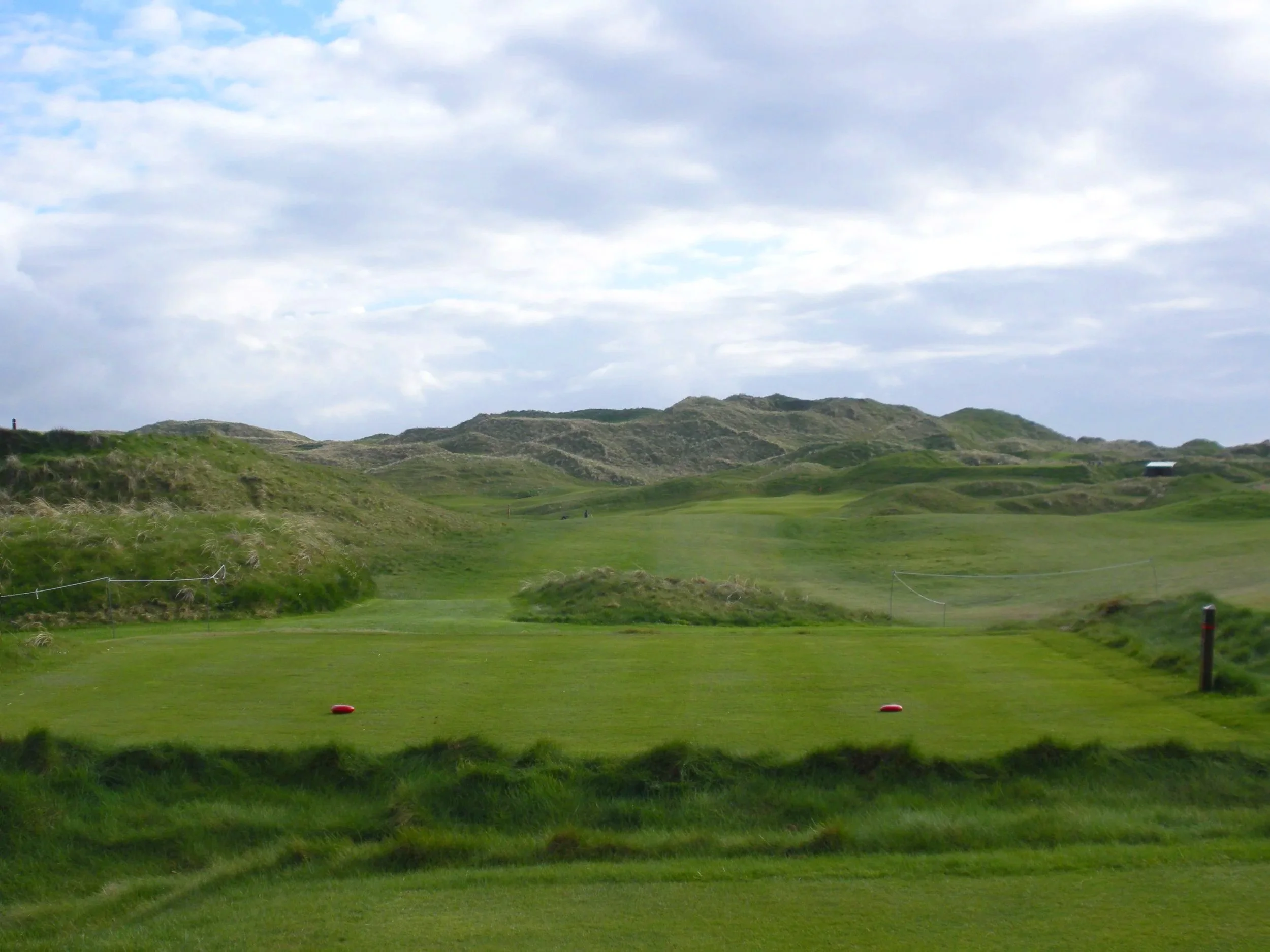
Built for Healthy Turf
Teeing grounds come in all shapes and sizes but there are a few universally agreed-upon design, construction, and maintenance keys to healthy tee turf:
Size – the tee has to be appropriately sized based on the amount of play that it will receive, with consideration given to the type of golf club that is most likely to be used. If iron shots are the norm (e.g. on short to mid-length par-3 holes), the tee needs to be larger to allow for divot recovery.
To ensure adequate teeing ground, a rule of thumb for sizing tees is 100-200 square feet (10-20 square meters) of tee space on a hole for every 1,000 rounds in a year. That number should be 1.5 to 2x higher on par threes and for starting holes (typically the 1st and 10th holes). As an example, if a golf course averages 40,000 rounds per year, there should be at least 4,000 sf of tee space on most par-4 and par-5 holes and at least 6,000 to 8,000 sf of tee space on the par-3 holes, plus the first and tenth holes.
For golf courses in seasonal markets, another way to estimate size is 1 square foot (0.1 square meters) of tee space on a hole per player during the busiest month (again, 1.5 to 2x higher for par-3s and starting holes).
The smallest desired individual tee size is 300-600 square feet (30-60 square meters) for tees that are unlikely to be used very often. (The above standards are retrieved and adapted from https://golfcoursetrades.com/the-art-of-tee-box-design/)
Light and air flow – low and high vegetation should be cleared far enough away from all maintained turf to allow for adequate light and airflow. Tee boxes are no exception.
Access for Maintenance Equipment – consideration needs to be given to how maintenance equipment will access the tees. This includes the steepness of the banks around the tees, the opportunity to turn machinery without undue repetitive compaction, and the number of access and egress points for both golfers and equipment.
Shape and Width - The shape and width of a tee will also impact the efficiency of its maintenance. The preferred minimum effective width of a teeing area is 15’ (4.5 meters). Triplex mowers are typically 5-7’ (1.5 – 2 meters) wide, so a tee that is 30’ (9 meters) wide can accommodate two distinct tee settings and will not require additional passes with the mower. (Retrieved and adapted from https://www.golfcourseindustry.com/article/practical-tee-design--design-column-/)
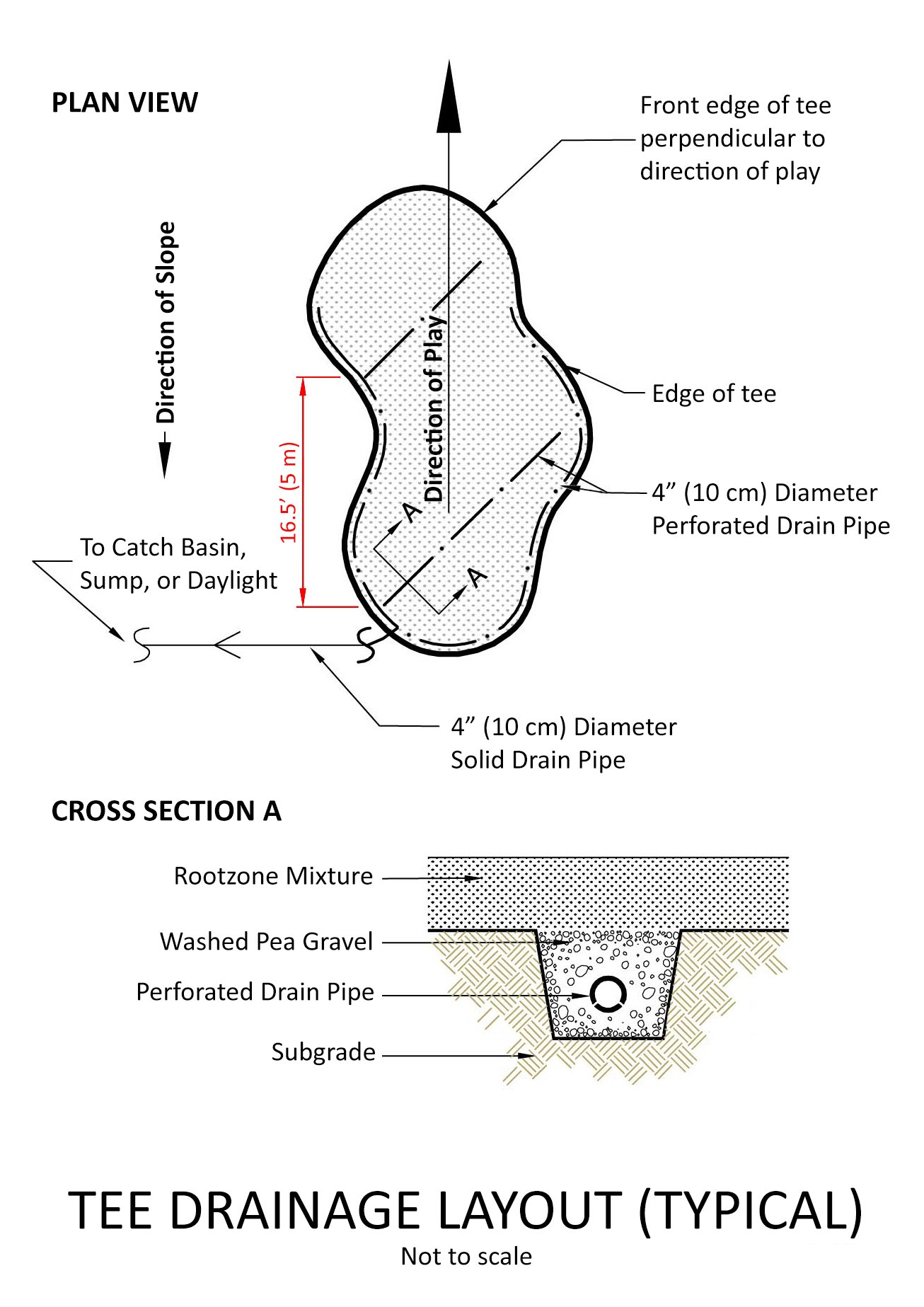
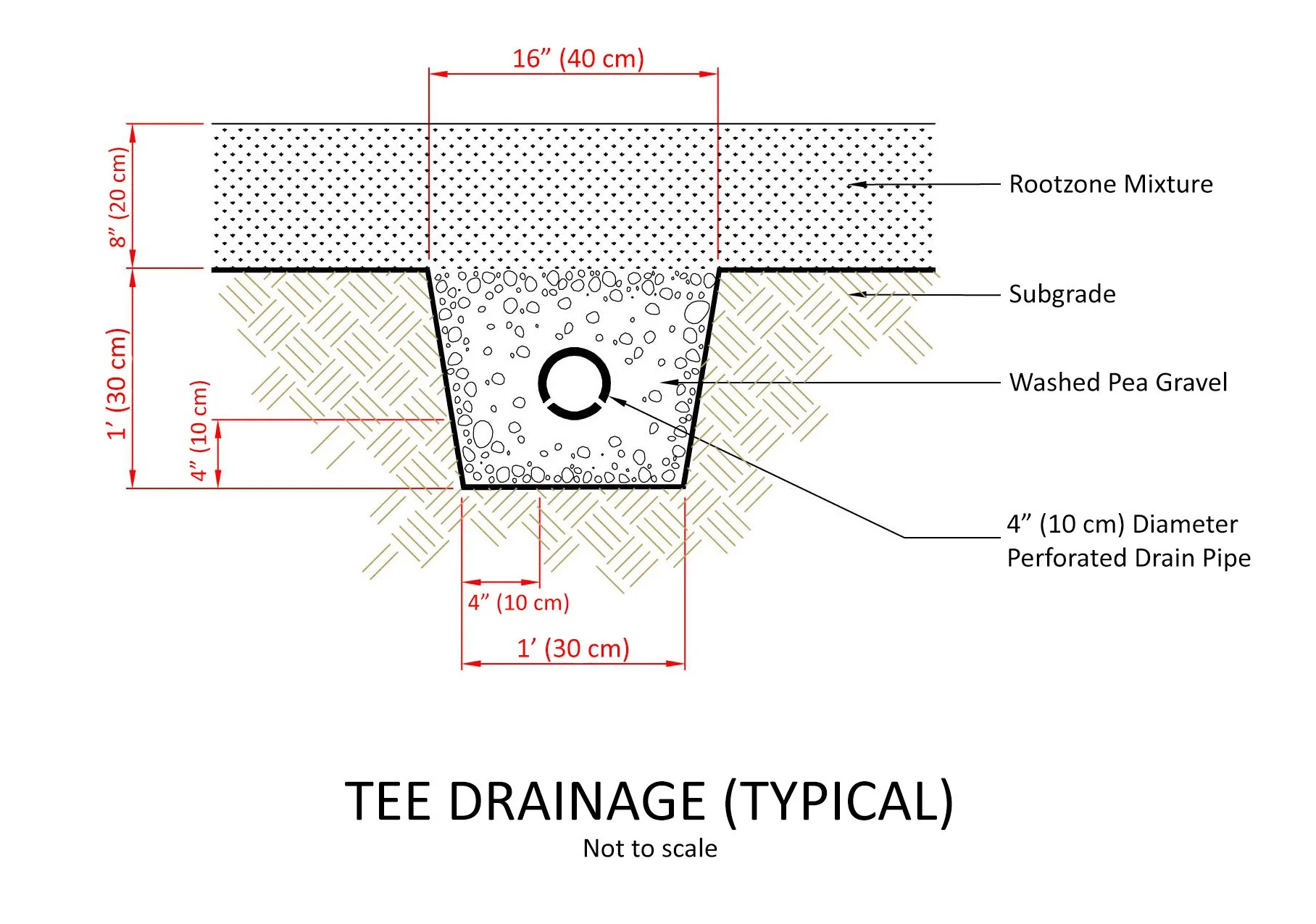
Drainage – since tees are flat or nearly flat (generally 1% to 1.5% slope maximum), the cost and benefit of including drainage has to be carefully considered. If the soil on a site is sandy and free draining, if overland runoff is properly directed away from the tee, and if rainfall intensity is typically low, then subsurface drainage may not be necessary. Heavier soils or frequent and intense rain events make the use of subsurface perforated drainage pipe a good idea for healthy turf. If the budget allows for it, a rootzone up to 8” (20 cm) thick can be imported as the growing medium. The consulting agronomist can help the golf course architect to specify the ideal mix and to source the rootzone material.
See below for typical tee construction details:
“Ideal” Tee Yardages
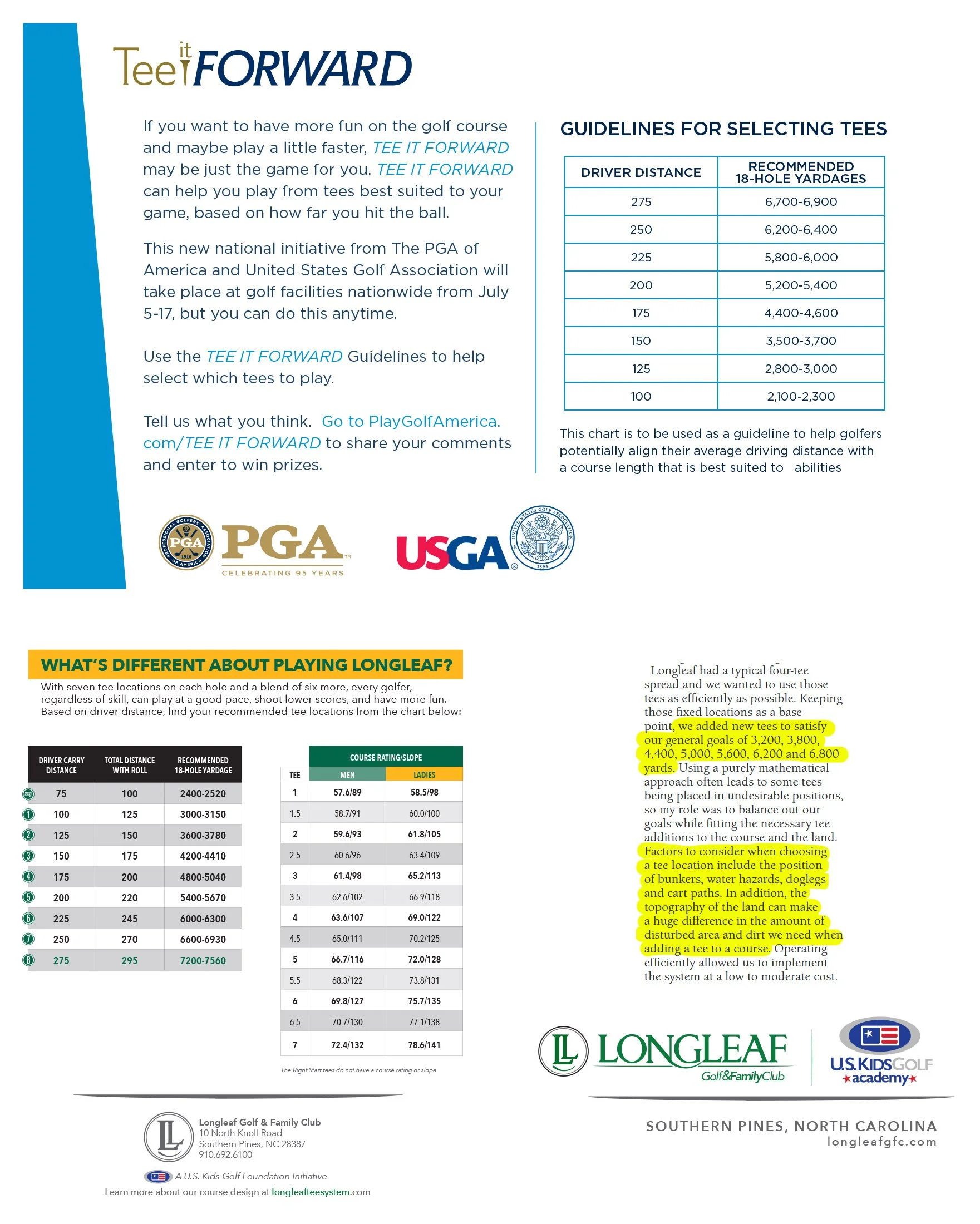
The length of the golf course from the back tees (or “the tips”) usually gets the most attention even though that yardage only applies to a small number of (predominantly male) players. According to research conducted by the USGA and published in 2022, golfers use the back tee less than 10% of the time on golf courses that are longer than 6,600 yards and only 3% of the time on golf courses longer than 7,000 yards. This suggests that most golf courses in the U.S. currently have adequate back tee yardage for the vast majority of golfers. It’s worth keeping this conclusion in mind when designing a new golf course, as the additional cost of acquiring and maintaining enough land to safely accommodate a golf course of 7,000+ yards will likely not be justified by the relatively small number of players that consistently use the longest tees.
The same USGA research suggests that that aren’t nearly as many forward and female-rated tees available to female golfers as tees available to male golfers. As of 2022, the median forward tee yardage for 18-hole golf courses in the U.S. was 4,952 yards. Based on use patterns in score posting data, forward tees closer to 4,200 yards are needed to give female players the same flexibility of choice that many male golfers enjoy on average.
The forward tee yardage recommendation of roughly 4,200 yards (and as short as 2,100 yards (based on driver carry distance) for beginners, seniors, and others with slower swing speeds) is reinforced by research and recommendations made by tee positioning consultants Arthur Little and Jann Leeming, the ASGCA’s Longleaf Initiative, and the USGA and PGA of America’s Tee it Forward program.
Stepping back, the ultimate primary goal of all of these initiatives is to have golfers play the tee that is most appropriate for their swing speeds and skill levels. In theory, this will make the game more fun for that individual (hopefully leading to more trips to the golf course) and also will theoretically lead to a more global speeding of the pace of play, making the game more enjoyable and accessible for all players.
From a design and operational standpoint, proper tee selection might also be encouraged by changing the way the tees are identified (the color red is now widely stigmatized as the “women’s tee color” so men tend to be reluctant to play from red tees or tee decks that are shared with red tees).
Golf course architects should work with course owners and operators to provide several well thought-out tee locations and distances to give players the option to play from tees appropriate to their skill level and swing speed.
Other Design Considerations
The slope of the surface of the tee (again, typically 1-1.5%) should flow with the ground. In other words, if the ground is falling to the right, the tee should be sloped to the right so the slope of the teeing surface (necessary to surface drain water across it) is less perceptible to the human eye. (retrieved from Hanse, G. (2021, April 27). Gil Hanse’s Architecture 101: Still On the Tee. LINKS Magazine. https://linksmagazine.com/gil-hanses-architecture-101-still-on-the-tee/)
In Dr. Alister MacKenzie’s “Thirteen Essential Features” of an ideal golf course, he wrote, “There should be little walking between the greens and the tees, and the course should be arranged so that, in the first instance, there is always a slight walk forwards from the green to the next tee; then the holes are sufficiently elastic to be lengthened in the future if necessary.”
Stylistic decisions on whether tees should be geometric or more “natural” are more in the realm of aesthetic decisions that should be addressed on a case-by-case basis.
Designing Sustainability and Accessibility into Tees
The tee is a unique element on the golf course in that it is the only area from which all golfers will be hitting shots. Ideally, the golf course architect will carefully consider how to give the players hitting shots off each tee equitable views, “shot values”, and strategic interest so that players of all abilities can enjoy the playing experience.
The PGA of America has published guidance on the placement of tees called Setting Up Golf Courses for Success: A Critical Factor in Attracting More Women to Golf. I believe that the ideas presented are universally applicable so I’ll quote some key points directly from this document and recommend it for further reading.
“Appropriately placed tees can accommodate golfers with slower swing speeds or shorter length of drive, including new golfers, seniors, youth, and people with disabilities…. Golfers recovering from physical, cognitive and/or mobility limitations, injuries or surgeries can re-engage with golf more quickly from tees with yardages suited to their abilities.” (PGA of America, Setting Up Golf Courses for Success: A Critical Factor in Attracting More Women to Golf, p.2)
“The primary course attributes to consider when creating a fair course set up for women and men of all abilities are a) the positioning of tees and b) the location of cross hazards that create forced carries.” (ibid, p.3)
“The basis of good tee positioning is rooted in the concept of design fairness. The central idea of this philosophy is that golf course operators should provide sets of tees from which golfers with a wide spectrum of driving distances and swing speeds can reach greens in regulation and putt for pars or even birdies. Done correctly, the tees should be positioned proportionally to each other, so that players who are playing the correct set of tee markers for their driving distance and swing speed may use similar clubs for their approach shots on each hole.” (ibid, p.4)
Unfortunately, the placement of forward tees is often an afterthought. The placement of any tee should give full consideration to angles, distances, visibility, and forced carries (in addition to positioning relative to bunkers, water hazards, doglegs, and cart paths) to ensure that shot values are similar for, and hole strategy can be equally enjoyed by, both long and short hitters.
Much of this discussion also ties into the design of the landing areas. Contours that kick the ball forward (speed slots) and mounding to keep the ball within the fairway and away from hazards can be designed into the short-hitter’s landing area to make the game more fun and interesting for less skilled players without impacting the challenge for more advanced golfers. In addition, contours that emphasize and enhance the ground game (rather than contours that repel shots with a lower trajectory) can help higher handicap golfers reach and hold the greens with longer irons and fairway woods. (guidance from Kari Haug)
Finally, in terms of physical accessibility, the golf course architect should also strive to design tees that:
Ensure access for mobility challenged golfers by minimizing steep slopes and stairs and considering entry and exit points from cart paths.
Minimize long or steep walks from the previous green to the greatest extent possible to enable and encourage walking.
Keep clear sight lines from adjacent holes to ensure that players who are standing on the tees can see and be seen by others and to better accommodate the hearing impaired (who are less likely to hear a shouted warning about an incoming wayward shot).
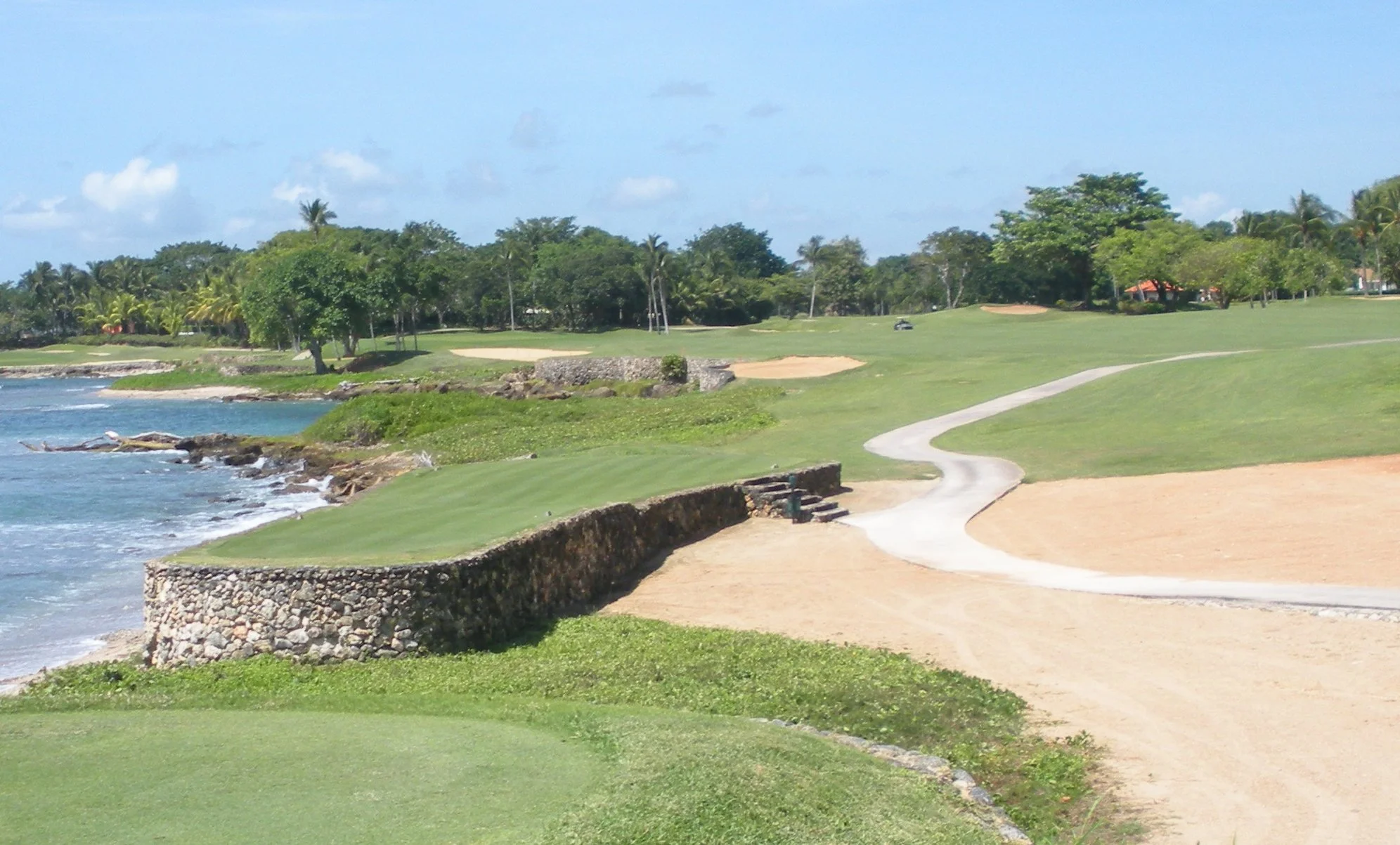
An example of a tee that is not very physically accessible, for players or maintenance equipment
Contact Sustain Golf for more information!
We firmly believe that common sense sustainable design, construction, and maintenance practices are the keys to the long-term outlook for the game of golf. We at Sustain Golf aspire to be on the leading edge of applying sustainability concepts to golf course design and construction.
We would also be happy to answer any questions that you might have about sustainable golf course design, maintenance, and construction. Visit us at www.sustaingolf.com or contact us at the following email address for more information: matt@sustaingolf.com.
Up Next:
Step 12 – Feature Construction Spotlight: Sand and Grass Bunkers
References:
Hanse, G. (2021, April 27). Gil Hanse’s Architecture 101: Still On the Tee. LINKS Magazine. https://linksmagazine.com/gil-hanses-architecture-101-still-on-the-tee/
Hanse, G. (2021, February 24). Gil Hanse’s Architecture 101: Now On the Tee. LINKS Magazine. https://linksmagazine.com/architecture-101-lesson-9-golf-tee/
Hurdzen, Dr. Michael J. Golf Course Architecture: Design, Construction & Restoration. Chelsea, MI: Sleeping Bear Press, 1996.
Information on tee sizing and maintenance retrieved and adapted from https://golfcoursetrades.com/the-art-of-tee-box-design/
Information on tee sizing and maintenance retrieved and adapted from https://www.golfcourseindustry.com/article/practical-tee-design--design-column-
PGA of America, Setting Up Golf Courses for Success – A Critical Factor in Attracting More Women to Golf. Retrieved from https://www.accessgolf.org/naag/assets/File/public/resources/SettingUpCourse_final.pdf
USGA Home Page, Tee Options on Golf Courses: Supply, Demand and Opportunities. USGA; 2022. Retrieved from https://www.usga.org/content/usga/home-page/course-care/green-section-record/60/16/tee-options-on-golf-courses.ht
Photo Credits:
Matthew Schiffer, Lahinch Golf Club
Matthew Schiffer, Teeth of the Dog Golf Course, Casa de Campo Reso
Peer Review:
Dr. Keith Duff, former UK government wildlife agency Chief Scientist, current Golf Environment Consultant
Kari Haug, EIGCA, Golf Course Architect, Kari Haug Planning and Design, Inc.