
Step 12: Feature Construction Spotlight - Sand and Grass Bunkers
Key Points
Sand bunkers come in all shapes and sizes, limited only by the imagination of the golf course architect and the client’s construction and maintenance budgets. Regardless of the form, to maximize the function and effective life of the sand bunkers, they should all be designed and built to encourage rapid drainage, minimize contamination of the bunker sand by silt and soil, and reduce the movement of bunker sand from the face of the bunker to the bunker bottom.
A final important design consideration is how the bunkers will be maintained. Will the bunker be large enough and easily accessible so that it can be raked mechanically (e.g. Sand Pros, bunker rakes) or will the sand need to be raked by hand? How about the grass on the bunker faces and surrounding mounds and hollows – can a triplex mower, Ventrac, or Toro Sidewinder manage the terrain or will the slopes be so steep that the job requires smaller machinery such as a fly mower? The number of man-hours needed to maintain the bunkers is a big piece of the annual maintenance budget so efficiency and ease of maintenance should at least be considered.
In the interest of accessibility and inclusion, the golf course architect should also give thought to how golfers of all physical abilities can safely walk into and out of the sand bunkers.
Given the cost of sand bunker maintenance it is also wise to examine whether expectations for perfect consistency are realistic and if limited maintenance resources might be better used on areas that receive more play (e.g. greens).
Where budget is a concern, the golf course architect can have a positive impact on the long-term economic sustainability of a golf course by minimizing the size and number of sand bunkers and by sourcing sand locally. Grass hollows, mounds, swales, and waste bunkers can all be good substitutes to formal sand bunkers without sacrificing strategy or aesthetics.
Sand bunker construction is a multi-step process that needs to be coordinated with drainage and irrigation installation. There are differing opinions on the best time to install perforated subsurface drainage pipe within the bunker (if it’s deemed necessary) but care must be taken to avoid clogging the pipe with silt from adjacent construction activity before the grass has established.
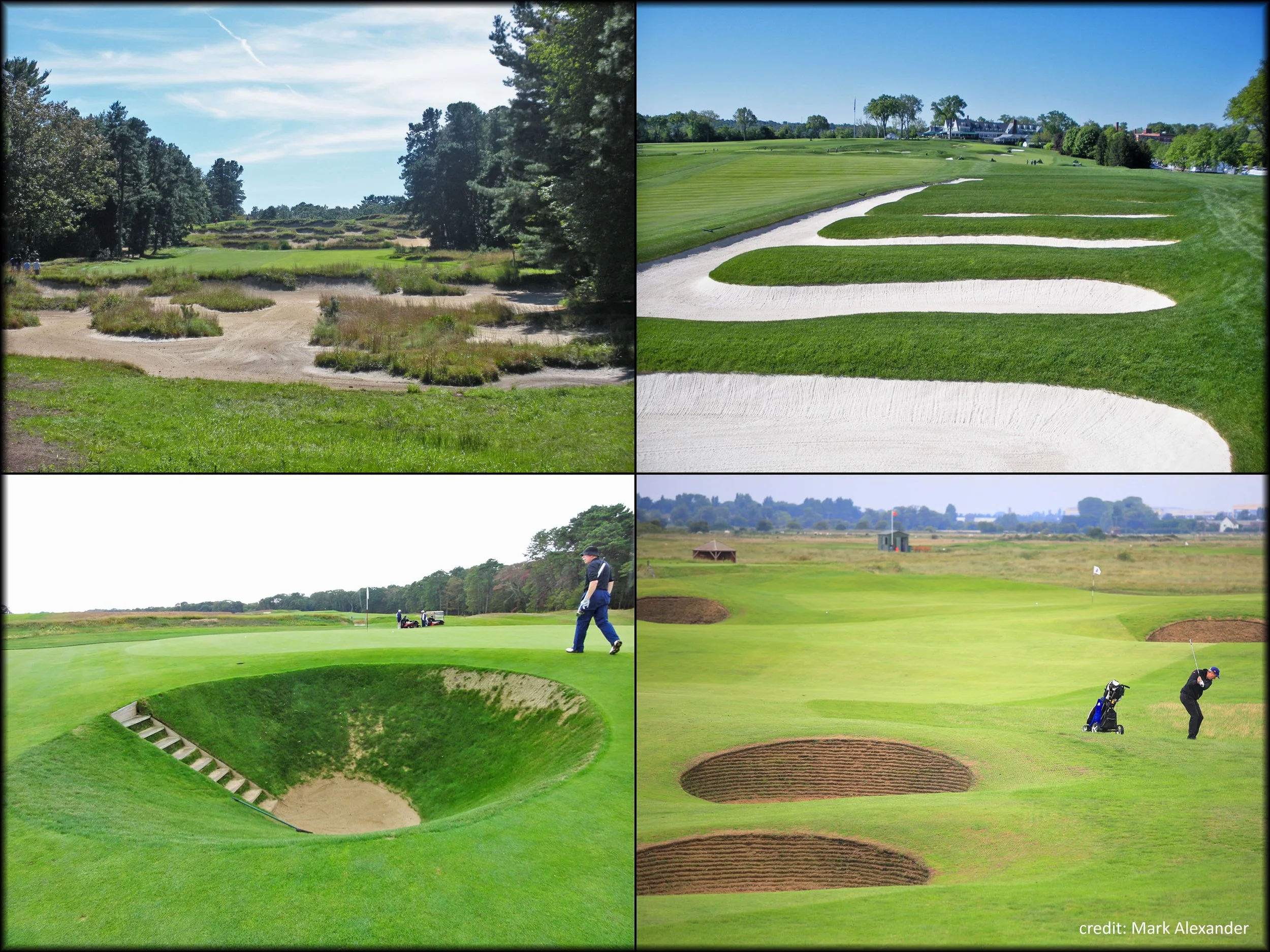
A variety of bunker styles - ideally the form follows the function
Sand Bunker Form and Function
The golf course sand bunker originated on the linksland of coastal Scotland more than 200 years ago. The original “sand bunkers” were the result of strong winds and erosion on the early links with a helping hand from rabbits and sheep, who would burrow and dig into the sandy soil in search of shelter from the elements. As the game became more popular, people began building golf courses further away from the coast and in heavier soils, and sand bunkers began to be intentionally constructed as a strategic hazard and, later, as an aesthetic feature.
Today, there is seemingly infinite variety in the form of sand bunkers – sand bottomed or grassy hollows; high sand flash, grass faced, or stacked-sod revetted face; formal or naturalized edges; gentle and shallow or severe and deep. Some forms (e.g. bunkers with high and steep sand faces; bunkers that require extensive hand maintenance) are much more expensive to maintain. Other bunkers (e.g. revetted sod) will have a shorter lifespan and require more frequent repair and replacement. That’s why it’s always a good idea for the golf course architect to discuss budget and maintenance expectations with the client and golf course superintendent prior to finalizing the design. Once the construction budget and ongoing maintenance expectations are understood, the style and form of the bunkers on a golf course is limited only by the imagination of the golf course architect and the ability of the contractor and/or shaper to physically manifest that imagination.
There are, however, some typical construction practices that will help to ensure that a bunker of any form or style will function properly and enjoy a longer lifespan (by draining quickly, minimizing contamination of the bunker sand with silt or soil, and reducing movement of sand from the bunker face to the bunker bottom). Furthermore, there is an obvious connection between how well the bunkers are functioning and how costly and time consuming they are to maintain, which plays a big role in the maintenance budget and, ultimately, the economic sustainability of the golf course.
The following steps illustrate how bunkers move from a concept to reality:
Differences in Design Detail
As discussed in Step 2 – The Various Modus Operandi of Golf Course Architects, there are different philosophies for how detailed the bunker design should be pre-construction. Some golf course architects work out most of the details during the design phase, provide extremely detailed grading and drainage plans to the contractor, and make only small modifications in the field as required. Other golf course architects start construction only knowing the total budget for sand bunkers and the general location for bunkers, but retaining more license to determine exactly where and how large each of the individual bunkers will be as construction progresses. The ease of the site for shaping and the golf course architect’s relationship with the client and the people building the bunkers will determine which of these approaches makes the most sense.
Approval in Subgrade
Mass grading operations will raise or lower the disturbed areas on the site to within 2 or 3 feet (1 meter) of design finished elevation. Rough and fine shaping operations will then progress from hole to hole and will shape the bunkers to subgrade levels (not including sand cap or topsoil) in the locations, sizes, and forms that the golf course architect specifies.
The golf course architect will inspect, tweak, and approve each of the bunkers at their subgrade levels. This approval gives the “bunker crew” (whether under the direction of the contractor or a shaper) license to proceed to the finishing steps.
Finishing the Bunkers
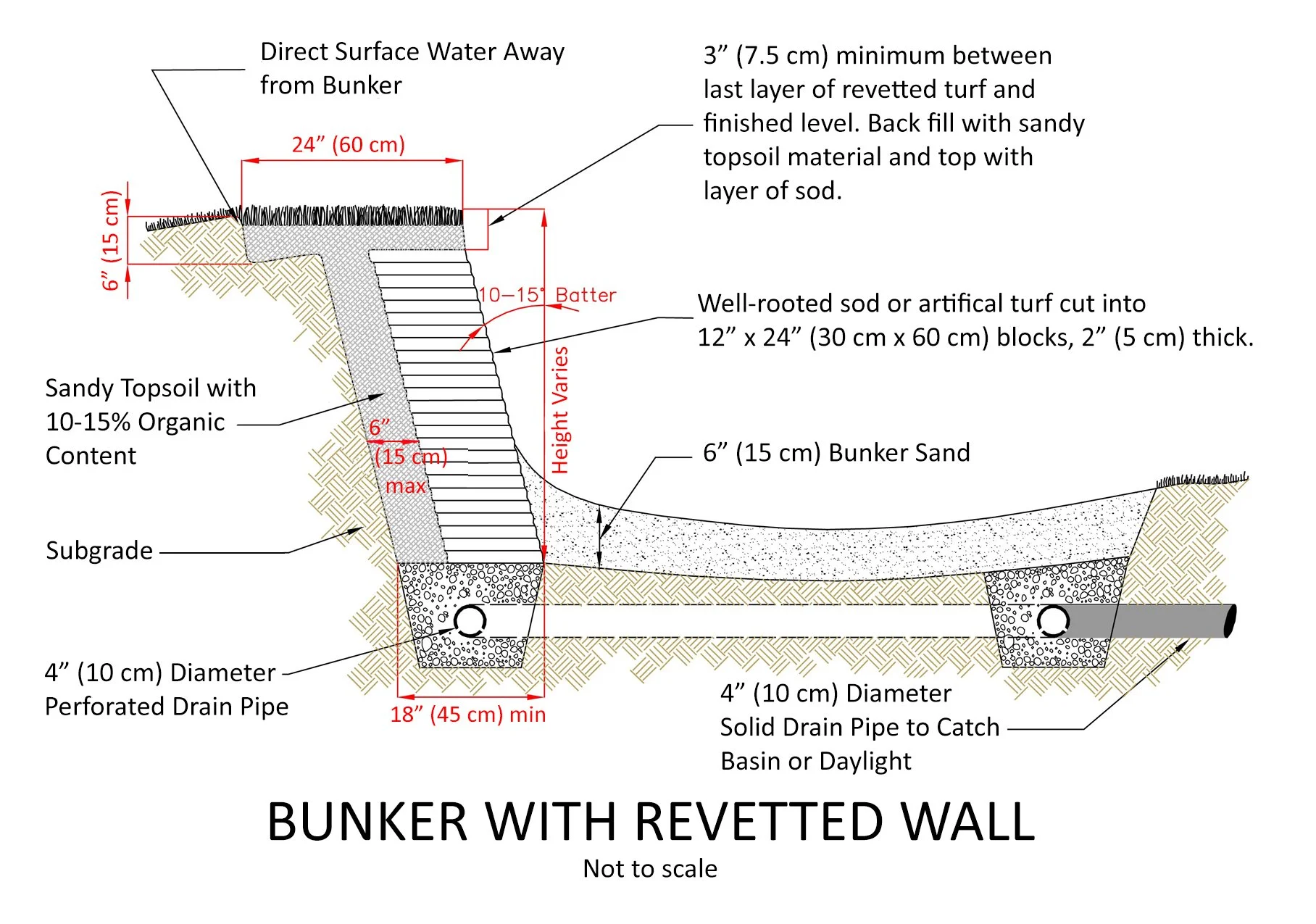
“Finishing” the bunker includes placing topsoil or a sandcap to bring the area surrounding the bunker up to finished grade and using small machinery and hand labor to get all of the bunker surrounds and the bunker floor (or bowl) finalized, compacted, and stabilized. Depending upon the steepness of the proposed bunker face, a stabilization product, aka “bunker liner” (in the form of fabric, blanket, spray, sod, impermeable or permeable layer, etc.) that is designed to hold the bunker sand in place may need to be applied/installed at this time. If the bunker is to be revetted, the stacked sod (or artificial turf) wall will be built during this step (see detail below). The installation of nearby irrigation and drainage may also be happening simultaneously.
Briefly, on bunker liners – there are now a wide variety of products that are designed to hold bunker sand in place, minimize soil and silt contamination, and pull moisture away from the sand. In some cases, the climate makes these products seem to be a necessity (e.g. frequent, heavy rains causing wash-outs or near constant high-wind conditions making it difficult to keep the sand in place). In other cases, the design concept (e.g. very steep sand faces) will be the reason why these products are called for. When budget is a concern, a design solution can usually be found, even in difficult climates, to make the sand bunkers functional and visible without additional stabilization measures.
Adding Drainage to the Bunkers
Since a bunker is often lower than its immediate surroundings, it is imperative that the bunker surrounds be graded to ensure a minimum amount of surface water is directed into the sand bunker. For the water that does enter the sand bunker (via rainfall and irrigation), the rapid conveyance of that water out of the bunker is a primary concern in its design and construction.
Golf courses that are built upon free-draining sand can often rely upon rapid infiltration and can likely forego subsurface bunker drainage. Most golf courses are not built upon free draining sand, however, and would therefore benefit from at least some subsurface pipe at the low point(s) of the bunker (whether grass or sand) to rapidly remove the nuisance water that will otherwise collect.
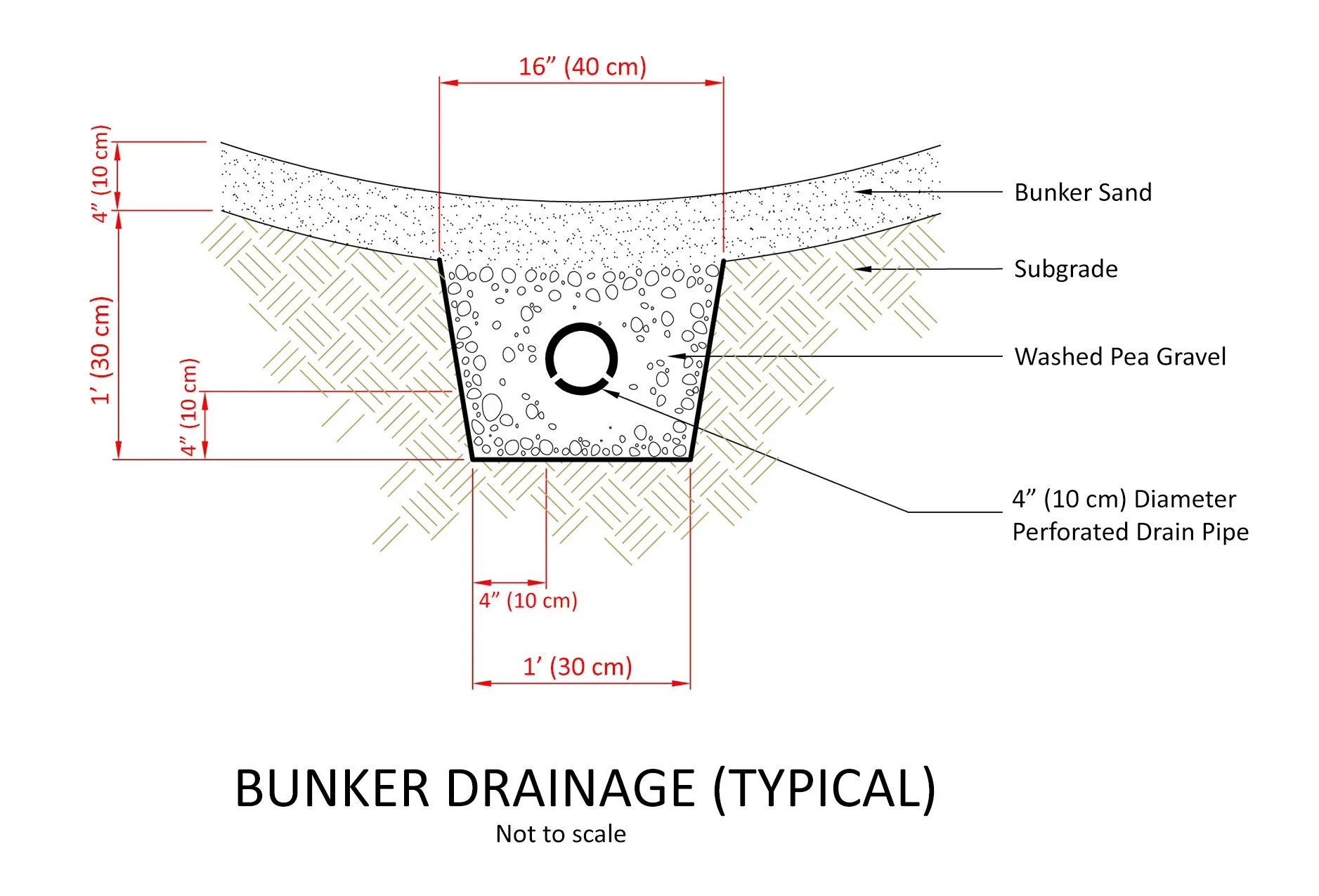
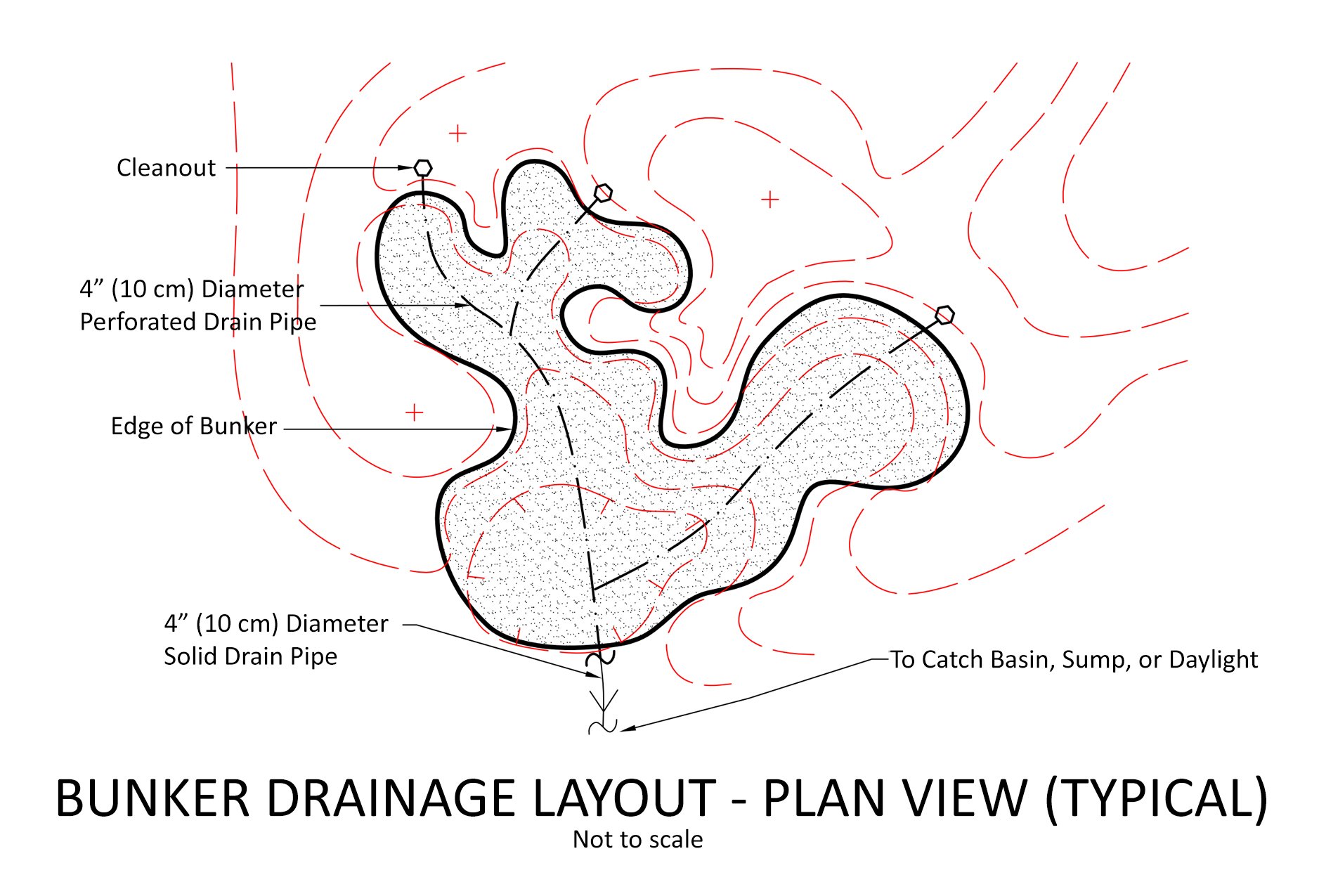
The subsurface drainage pipe within the bunker bowl will often be perforated and within a gravel trench and will connect to a solid drainage take-away pipe that is outside of the bunker. The solid pipe will bring the water to either a nearby drainage sump, into the larger subsurface storm drainage network, or will daylight to a SuDS conveyance feature such as a small stream or a broad, shallow channel that is full of native plant life (see Step 8: Storm Drainage Design and Installation & An Overview of SuDS for more information). A “clean-out” pipe riser should also be added on the high side of the bunker, which will allow the maintenance staff to blow-out the perforated pipe and gravel trenches with water or air should they become clogged with silt and stop draining as quickly.
There are different theories about the best time in the construction process to install the interior, perforated pipe, but it is common practice to install the exterior, solid take-away drainage pipe while the bunker is being finished. One common practice in climates with more intense precipitation is to wait to install the interior, perforated drainage pipe and gravel tranches until after grass has established around the bunker and just before placing the sand. This is due to the possibility that, without grass to catch it, silt and soil kicked up by adjacent construction activities can wash into the bunker and clog the perforated pipe and gravel trenches, causing them to function less than optimally.
See the following construction details for a common method of bunker drainage:
Grassing
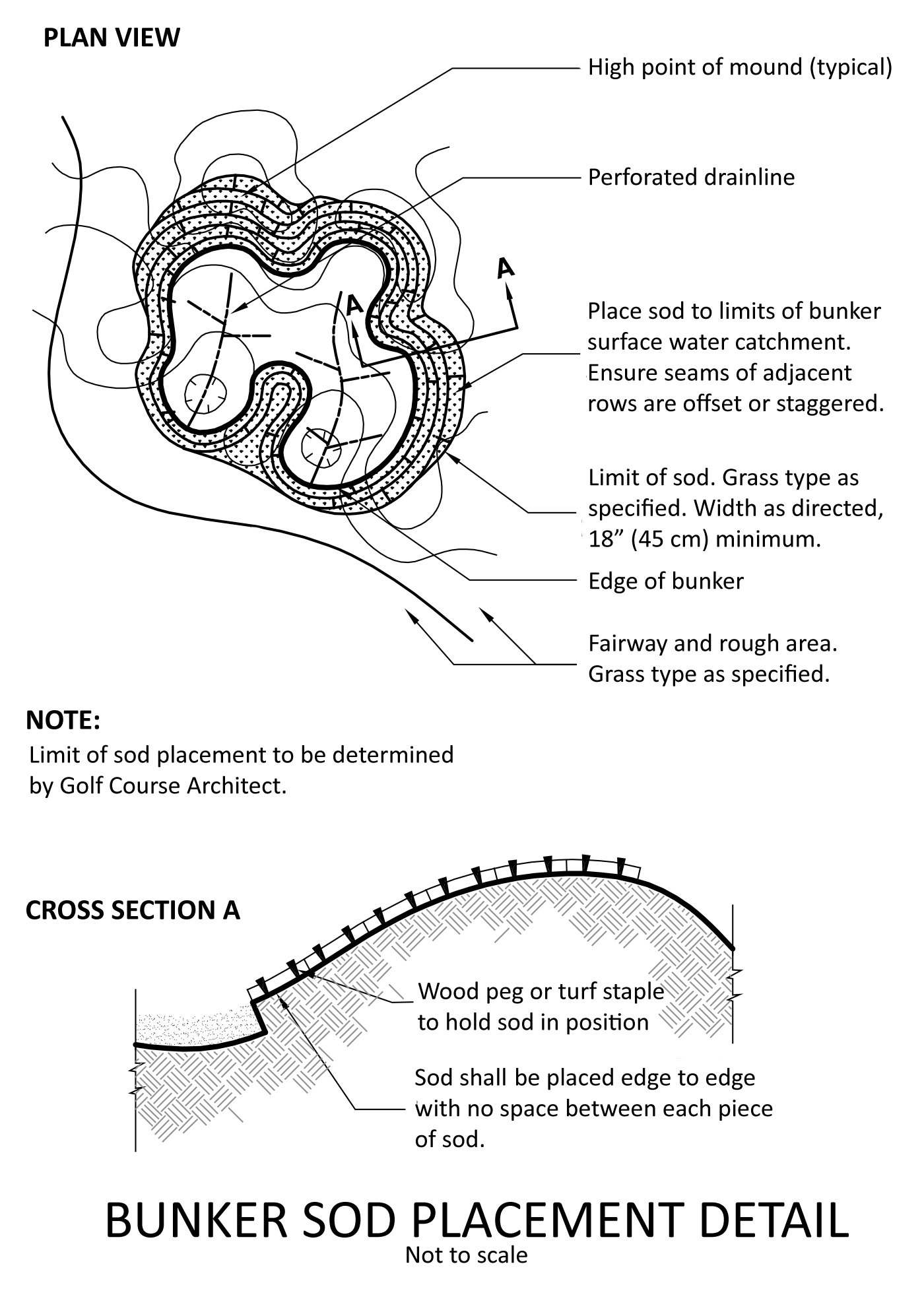
Once a bunker has been finished and stabilized to the satisfaction of the golf course architect, and the disruptive activity of nearby irrigation and drainage pipe installation is complete, the next step is to establish grass around the edge of the bunker, which will help to prevent soil and silt from washing into the bunker bowl. For grass bunkers and hollows, grass is established within the bowl too. Sod is typically used because it establishes significantly faster than seed (and helps to avoid the issue of erosion), even though it is more expensive initially.
Below is a typical construction detail for sodding around the perimeter of a new sand bunker:
Edging, Perforated Drainage, and Sand Placement (for Sand Bunkers)
Once grass has established around the perimeter of the sand or grass bunker bowl, the final details can be completed by the bunker crew.
Edges can be cut or “chunked” to match the look desired by the golf course architect. Both formal and more “natural” bunker edges will be perfected by hand labor.
The interior perforated drainage pipe will be installed (if it hasn’t been already) and connected to the exterior solid take-away pipe.
The bunker sand that has been selected by the consulting agronomist and the golf course architect is spread and compacted to the desired depth, often 4” to 6” (10 to 15 cm). Space may be left between the edges of the bunker bowl and the sand during grassing and grow-in to collect any silt or debris that may still wash into the bunker before full establishment of the grass.
Bunker sand is typically selected and sourced during the early phases of construction based on physical and aesthetic characteristics, availability, and cost. The consulting agronomist and golf course architect will make recommendations and the contractor will source samples for approval.
Final detailing and clean-up can happen by hand after the surrounding ring of turf has adequately established.
Sustainability and Accessibility in the Design and Construction of Bunkers
There is widespread discussion in the golf industry about the constant “state of perfection” and consistency that is now expected of sand bunkers by golfers (see Rethinking Bunker Maintenance, George Waters, USGA Green Section, as one example). As the result of countless hours spent by the maintenance staff to meet the heightened expectations of today’s golfer, what was once meant to serve as a penalty is now often much less than that for the better players (while still penalizing high handicap golfers). In extreme cases, bunker upkeep and maintenance accounts for as much or more labor expense as putting greens, where much more play takes place! Whether or not this is a good use of limited resources is another discussion topic.
Outside of the maintenance practices that happen once the golf course has opened, the golf course architect can have a big impact on the long-term economic viability of a golf course by the careful consideration of the actual purpose (and need) for each bunker as well as the selection and sourcing of the bunker sand. At most golf courses the maintenance budget won’t be unlimited, so what follows are some common-sense questions that golf course architects should ask themselves during the design phase:
How many bunkers does this golf course need and how large do they need to be for the intended strategy to work?
How steep and complex do the bunker faces need to be for good visibility and to administer the intended shot penalty? If they’re steep enough (or the climate harsh enough) to necessitate a bunker stability product (fabric, blanket, spray, sod, etc.), what’s the most cost-effective and maintenance-reducing product over the short-term and the long-term given an individual bunker’s size, location, and orientation? Is there a way to reconsider the design or placement of the bunkers so they can function without that stability product?
How will the bunkers be maintained? Small and intricately shaped bunkers with steep banks on all sides may be impossible to access by even small maintenance equipment (like a Sand Pro or bunker rake). These will require hand raking, which can be very costly in labor hours over the long-term. However, mechanical rakes can shorten the effective life of bunkers by damaging the bunker liner, contaminating the sand, and/or compacting the edge of the bunker where the machinery enters and exits.
Much like tees, multiple access points into the bunkers should be provided for both players and maintenance crew and equipment to alleviate turf wear and compaction.
Grass bunkers, swales, and mounds can be significantly easier and less expensive to build and maintain than sand bunkers. Are there places on the golf course where these features can be used instead of sand bunkers (to save the cost of sand and raking) without compromising visibility, strategy, or intended difficulty of recovery?

A purpose-built grass bunker at Bandon Dunes Sheep Ranch
Can sand with acceptable physical characteristics (particle size, particle shape, hardness, color) be quarried on-site or locally to reduce material costs and transportation costs, and to benefit the local economy?
When building revetted bunkers, does it make sense to use stacked recycled artificial turf rather than sod? This is a newer technique and, despite likely higher upfront cost, the bunkers have been shown to last longer with lower ongoing maintenance costs.
Are there instances where “waste bunkers” can be used instead of formal sand bunkers? Waste bunkers are different from sand bunkers in that they are not considered “specially prepared areas of sand” under the rules of golf and the golfer has more leeway in how they play from within them. For practical purposes, waste bunkers are more informal hazards that have elements of a sand bunker – sand, crushed shells, loose soil, vegetation – but don’t have the same specially sourced sand and aren’t maintained as intensively. These areas are therefore significantly less expensive than sand bunkers to build and maintain while still reinforcing the intended strategy. (As an aside, waste bunkers are also often more impactful for low handicap players than formal bunkers simply because they aren’t as perfectly maintained and predictable.)


The large waste bunkers at Sand Valley Resort are less labor intensive than sand bunkers to maintain and arguably equally effective aesthetically and as hazards.
Finally, accessibility to the bunkers by all golfers should also be considered. Will golfers with physical limitations be able to safely walk into and out of the bunkers? Multiple access points for golfers with physical limitations will make the playing experience more inclusive and will also help to distribute wear and compaction on the surrounding turf.
The answers to all of these questions will meaningfully impact the golf course’s construction budget and ongoing maintenance budgets so clear communication and understanding of the client’s expectations and budget is a must.
Contact Sustain Golf for more information!
We firmly believe that common sense sustainable design, construction, and maintenance practices are the keys to the long-term outlook for the game of golf. We at Sustain Golf aspire to be on the leading edge of applying sustainability concepts to golf course design and construction.
We would be happy to answer any questions that you might have about sustainable golf course design, maintenance, and construction. Visit us at www.sustaingolf.com or contact us at the following email address for more information: matt@sustaingolf.com.
Up Next:
Step 13 – Feature Construction Spotlight: Putting Greens
References:
Hurdzen, Dr. Michael J. Golf Course Architecture: Design, Construction & Restoration. Chelsea, MI: Sleeping Bear Press, 1996.
Richardson, Forrest L. & Fine, Mark K. Bunkers, Pits & Other Hazards. Hoboken, NJ: John Wiley & Sons, Inc., 2006
Waters, George. Rethinking Bunker Maintenance. Retrieved from https://www.usga.org/content/usga/home-page/articles/2018/06/rethinking-bunker-maintenance--embracing-the-imperfections.html
Photo Credits:
Photo collage - Mark Alexander, Matthew Schiffer
Sand Valley Golf Resort – Minneapolis Star Tribune (retrieved from https://www.startribune.com/sand-valley-golf-course-in-wisconsin-is-product-of-big-dreams/421692173/)
Peer Review:
Dr. Keith Duff, former UK government wildlife agency Chief Scientist, current Golf Environment Consultant
Brett Hochstein, Golf Course Architect, Hochstein Design, LLC