
Key Points
The consulting agronomist will test the irrigation water source and topsoil and then work with the golf course architect to determine the best turfgrass species and cultivars for the golf course’s greens, tees, fairways, maintained rough, and native out-of-play areas.
The National Turfgrass Evaluation Program (NTEP - https://ntep.org/) provides comparisons of the latest cultivars based on key physical characteristics - color, density, resistance to diseases and insects, tolerance to heat, cold, drought, and traffic – and is a good starting point when choosing turfgrasses.
The optimal growing temperature and humidity for a cool season turfgrass is different than that for a warm season turfgrass. They also differ in how they are established (seed or sprigs), how they propagate, and how they are maintained.
All turfgrass maintenance practices (e.g. overseeding dormant grasses, height of cut, amount of irrigation and fertilizer) can and should be evaluated for their long-term sustainability (cost versus benefit). On golf courses without a great deal of winter traffic, the costs of overseeding probably outweigh the benefits.
When it comes to pest management and cool season grasses, a return to simple time-honored maintenance practices might hold the key to greater sustainability.
Artificial turf is becoming a viable alternative to turfgrass for specific circumstances and applications.
Public and private institutions such as university breeding programs, the US Department of Agriculture - Agricultural Research Service (USDA-RSA), and private seed and sod companies are continually researching and developing new turfgrasses in an effort to enhance the positive traits and minimize the negative traits of common species and to make them better suited for many applications, including for golf courses. When selecting the turfgrasses for tees, fairways, greens, and maintained rough the consulting agronomist and golf course architect might consider any of the following characteristics:
Density
Color
Leaf texture
Shade tolerance
Wear tolerance
Heat tolerance
Drought tolerance
Salinity tolerance
Disease resistance
Time to establish
Recuperative ability (including divot recovery), and
Fertility and maintenance requirements
The National Turfgrass Evaluation Program (NTEP) is an independent, non-profit research organization that evaluates and compares the cultivars of seventeen different turfgrass species based on color, density, resistance to diseases and insects, tolerance to heat, cold, drought, and traffic. NTEP.org is an invaluable unbiased resource to refer to as the starting point in the turfgrass selection process.
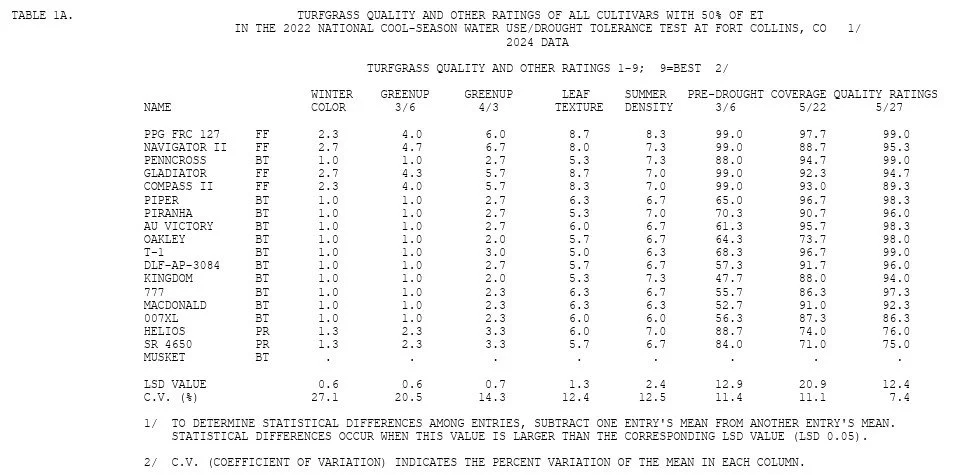
A comparison of turf cultivars taken from the NTEP website
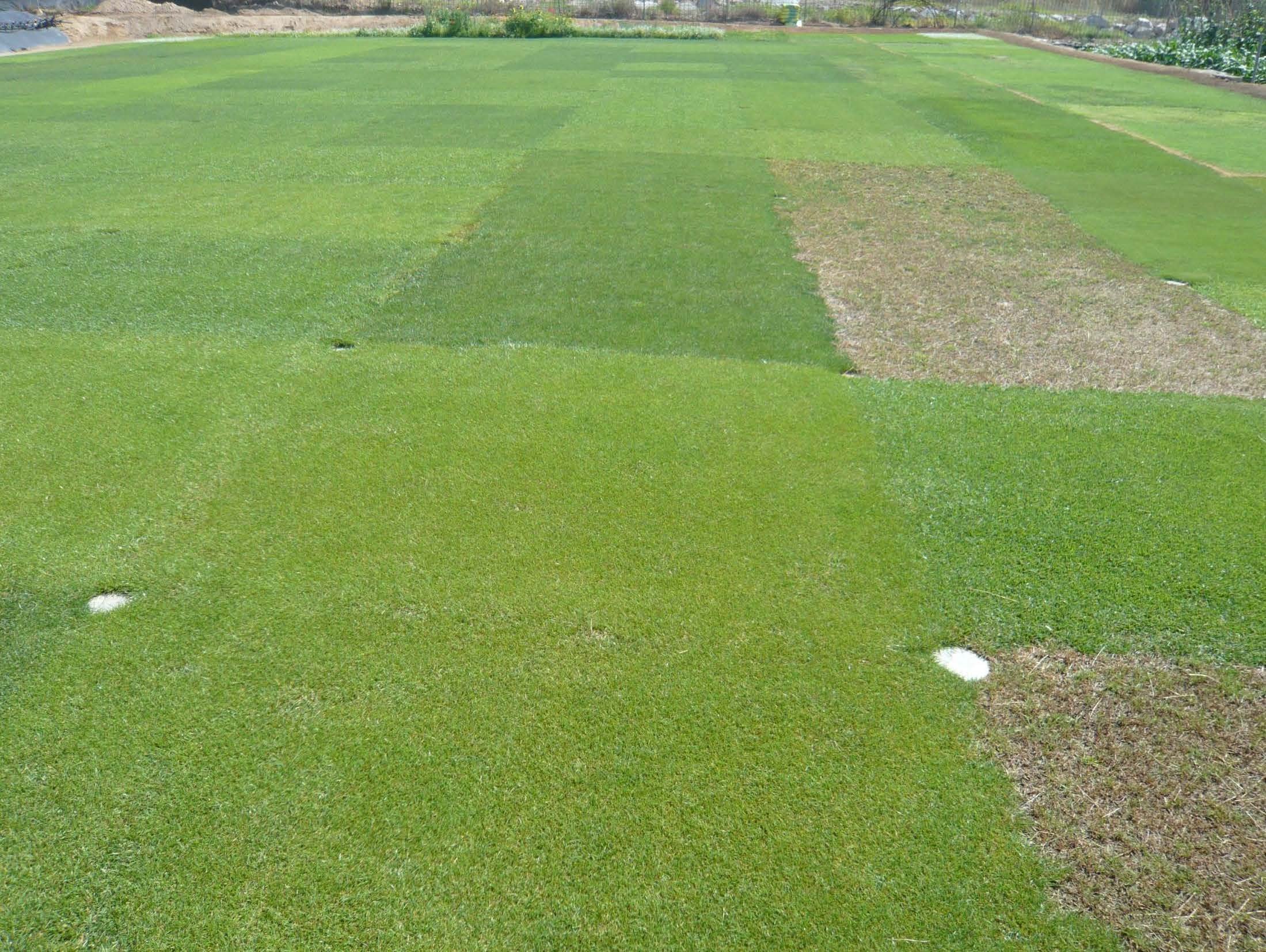
Test plots of turfgrass cultivars
An experienced consulting agronomist will know which traits each of the cultivar candidates on the NTEP lists were bred for and will use that knowledge, plus test results from the available irrigation water sources and topsoil, to determine the turfgrass species and cultivars that are most likely to possess the desired physical characteristics without requiring an unsustainable degree of maintenance.
One other characteristic to look for in fine fescues, tall fescues, and perennial ryegrass is the presence of fungal endophytes (designated as E+). An endophyte is a beneficial fungus that lives symbiotically within these turfgrass species and helps them to store and use water more efficiently, better withstand extreme heat and drought, and resist certain surface-feeding insects and fungal diseases. Many cultivars of these turfgrasses are now being bred with endophytes, which, under equal conditions, will require less water and fewer inputs (e.g. insecticide, fungicide) than the same turfgrass without the presence of endophytes.
Different Turfgrasses For Different Areas on the Golf Course
In some cases (but only for warm season species) it makes sense to select just one single turfgrass species for all of the in-play areas and only vary the amount of irrigation and height of cut based on the location (green vs tee vs fairway vs maintained rough). This can greatly simplify maintenance and make a golf course much more flexible if, for example, the superintendent wants to narrow or expand the fairways or aprons for tournament play.
However, it’s more often the case that different highly specialized turfgrasses will be utilized for different areas of the golf course. As an example, greens and tees are the most intensively maintained areas of the golf course (in terms of irrigation, height of cut, rolling, aeration, topdressing, fertilizer, fungicide, and pesticide) and are usually grassed with the finest leafed cultivars that can tolerate a low mowing height (typically highly-refined varieties of bentgrass in cool climates or Bermudagrass in warm climates).
Fairways, being slightly less intensively maintained, can accommodate cultivar(s) that are complimentary to the greens and tees turfgrasses but aren’t as refined (and can be less maintenance intensive (depending on the maintenance budget and expectations of the client)).
Maintained rough that is in-play is even less intensively maintained (and may or may not be irrigated) so an even less refined grass type can be specified for these areas that is often different in color or texture to the fairways. However, care must be taken to select grasses for the maintained rough that can remain low-cut and playable with minimum management required to control height and density. Ideally, the maintained rough should remain weed free, stable, and playable with little to no soil amendments, irrigation, or fertilizer.
Finally, native grasses and flora are often the most sustainable and cost-effective solution for native out-of-play areas. An evaluation of the site pre-construction and a survey of flora within the geographic area of the golf course will help determine the most desirable species that can thrive with a minimum of maintenance or attention.
Cool Season vs Warm Season Grasses
Cool season grasses are those turfgrasses that experience optimal growth conditions when the soil temperature is between 60 and 75° F (15.5 to 24° C). They perform best in cool and humid conditions found throughout the UK and Northern Europe. In the United States, cool season grasses are commonly seen on golf courses in the Northeast, the Northern Midwest, and the Pacific Northwest. Cool season grasses can also thrive in the cool, arid conditions of the Midwestern and Western United States, as long as irrigation is available. These turfgrasses will start to struggle when soil temperatures regularly climb above 80° F (27° C). When the temperature drops below the optimal range, cool season grasses will not go dormant, but growth and recovery will slow down significantly.
Species of cool season grasses that are most commonly grown on golf courses are:
Creeping bentgrass (Agrostis stolonifera),
Colonial bentgrass (Agrostis capillaris),
Fine fescue (Festuca rubra),
Strong creeping red fescue (Festuca rubra ssp. rubra),
Slender creeping red fescue ((Festuca rubra ssp. littoralis),
Chewings fescue (Festuca rubra ssp. cummutata),
Sheep fescue (Festuca ovina),
Hard fescue (Festuca brevipila),
Tall fescue (Festuca arundinacea),
Kentucky bluegrass (Poa pratensis), and
Perennial ryegrass (Lolium perenne).
Warm season grasses grow fastest when the soil temperature is between 80 and 95° F (27 to 35° C). In humid areas, such as Southern Europe and the Southeastern and Gulf Coast of the United States, the following warm season grasses can thrive for most of the year:
Bermudagrass (Cynodon dactylon),
Zoysiagrass (Zoysia),
St. Augustine (Stenotaphrum secundatum),
Bahiagrass (Paspalum), and
Centipedegrass (Eremochloa ophiuroides).
In arid regions, such as the Southwestern United States, Bermudagrass is most favored for its drought and heat tolerance.
Overseeding is Resource Intensive
When the soil temperature drops below the optimal range, warm season grasses will begin to go dormant and turn brown. This will usually not affect the turfgrass’s playing characteristics, but superintendents can overseed with a cool season grass (typically perennial ryegrass) to maintain a green color. Overseeding is most typically done on high-end private and resort golf courses where the player’s expectation is for lush and green turfgrass. Very heavy traffic can damage dormant turfgrass so that is also an important consideration in the decision whether or not to overseed (average to low levels of traffic will not cause lasting damage). Finally, overseeding with cool season turfgrasses actually puts extra shade stress on the primary turfgrasses and competes with them for water, nutrients, and light as temperatures begin to warm up in the spring, which is a downside.
There is also a transition zone between the north and the south where it is generally too hot in the summer for cool season grasses and too cold in the winter for warm season grasses. The typical solution for this is to overseed with a mix of cool and warm season grasses to maintain a green color and full density at different temperatures at different times of the year.
Alternatives to Overseeding
If very heavy traffic isn’t a concern, many golf course superintendents will forego overseeding and instead paint their dormant warm season grasses green. Painting rather than overseeding equates to savings on seed, water, fertilizer, plant protectants, and the time, fuel, and labor of overseeding and the additional mowing all winter that it will require. Painting also means much less down time for the golf course (a few days versus several weeks for overseeding). Finally, the playing conditions on dormant warm season grasses are typically faster and firmer, which is often desirable.
Alternatively, some golf courses will forego both overseeding and painting and just accept the color and texture contrast that comes with dormant turfgrass. A side benefit of this is that undesirable invasive turfgrasses and weeds that are not dormant are very easy to find and eradicate amidst dormant turf (by showing up as spots of green in a sea of brown).
Ultimately, if heavy traffic isn’t a concern, the decision to overseed and keep the grass green through dormancy (and the cost, time, and effort that it entails) comes down to player’s expectations – which can be changed!
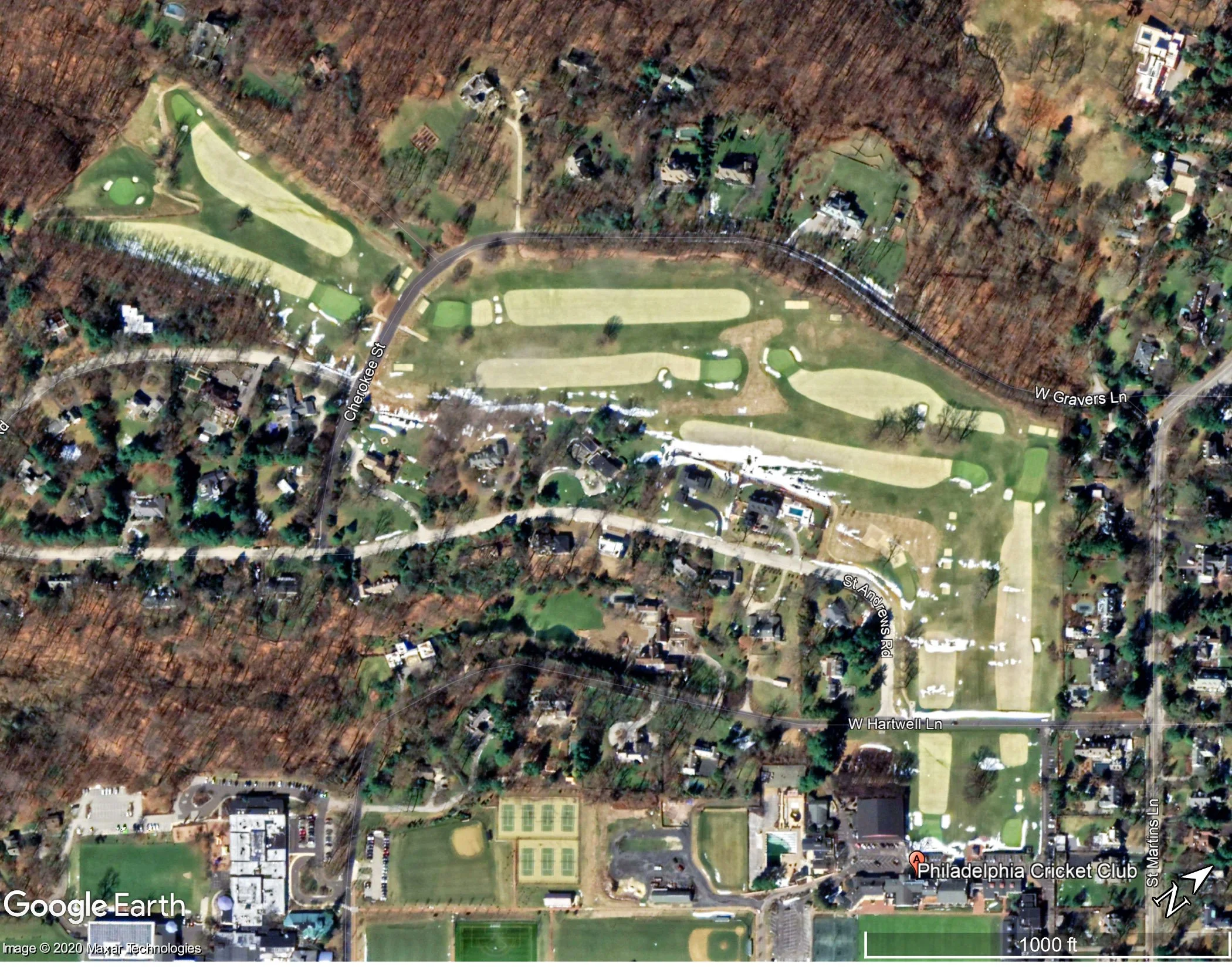
The Philadelphia Cricket Club St. Martins Course has a unique combination of bentgrass greens and Zoysiagrass fairways – seen here in winter dormancy
Sodding vs Seeding vs Sprigging
Cool season grasses are usually seeded or sodded.
Warm season grasses are most often vegetatively established (sprigs) or sodded, however many Bermudagrass and Zoysiagrass cultivars are now also available as seed.
In general, sprigs and sod will establish more quickly than seed but seed is preferable by almost every other measure:
Sprigs and sod are more expensive than seed (cost per acre),
Sprigs and sod cost more to transport in terms of money and carbon footprint,
Sprigs and sod are riskier to transport (can die if not planted quickly enough),
Sprigs and sod are more easily contaminated by weeds and bugs because they come with soil,
Sprigs have to be flooded once they’re planted, requiring more water than seeds (which only need to be kept moist).
If seeding, hydroseeding is the best option because the mulch and tackifier holds the seeds in place until they are able to establish as well as reducing the amount of water required.
Due to quicker establishment, sod is commonly used in the following areas that are most prone to erosion:
Ring around greens and tees
Green slopes and tee slopes
Ring around bunkers
Steep slopes
Ring around catch basins and manholes
Major drainage paths
Lake and channel banks
Sustainability in Grass Selection and Maintenance
Turfgrass science is an area where constant advances are being made in the furtherance of the sustainability of golf courses. A reevaluation of modern maintenance practices can also contribute to greater sustainability. Some examples of both advances in turfgrass and maintenance practices to be evaluated follow:
Seashore Paspalum (a type of Bahiagrass) is extremely tolerant of salinity, enabling it to be grown with very poor-quality water (salty water, gray water, and treated effluent). The water that is used to irrigate the grass will then be naturally filtered as it infiltrates and returns to the water table.
New strains of Bermudagrass are being developed that are extremely drought tolerant and have an improved cold tolerance, allowing for much lower water usage on more golf courses, moving farther north into the transition zone.
Historic and organic farming practices, such as Integrated Pest Management (IPM), are also being more widely adopted by golf course superintendents, necessitating fewer pesticides (and non-synthetic chemicals) and increasing biodiversity.
In northern climates, low-input fine fescues and creeping bentgrass were the dominant species on golf courses in the 19th and early 20th centuries. The wider use of irrigation and inorganic fertilizers in the middle of the 20th century (and calls from golfers for greener, shorter turfgrasses) created conditions that often allowed annual bluegrass (Poa annua) to outcompete the fine fescues and creeping bentgrass. As a result, Poa annua has become the predominant turfgrass on most northern golf courses - despite the fact that it generally requires more irrigation, fungicide, herbicide, and fertilizer and is less desirable as a playing surface for a number of reasons. A growing call for a return to low-input turfgrasses is starting to bring the situation full-circle, as superintendents have begun to focus on low-tech maintenance practices to create and maintain conditions that discourage the growth of Poa annua and allow the fine fescues and creeping bentgrasses to thrive once again (e.g. tree removal and shade management, improved drainage, less irrigation, less fertilizer, higher height of cut).
Mowing heights should be reconsidered for all turfgrasses. Tighter mowing places additional stress on turfgrass, making it more susceptible to weeds, pests, and disease, and intensifying turf wear. As a result, the turfgrass will require more intensive maintenance, including increased application of fertilizers, pesticides, and herbicides, to remain healthy.
Money, time, and energy can be saved, and turfgrass quality can be improved, by simply not cutting turfgrass as short, particularly on the greens, but also on tees and fairways. The primary challenge is to convince golfers to accept slower greens, which will likely have the added benefit of speeding the pace of play and making more pin locations available (see Step 13: Feature Construction Spotlight – Putting Greens for more detail).
Artificial Turf
Finally, artificial turf technology has advanced to the point where its playing characteristics are now comparable in many ways to natural grass. Artificial turf needs very little maintenance and it doesn’t require pesticides, herbicides, or water.
There are certainly still some drawbacks to artificial turf:
It would be prohibitively expensive to install artificial turf for large-scale applications,
Artificial turf greens are less receptive to long shots than natural grass greens,
Artificial turf is a petroleum-based product that creates pollution and waste in the manufacturing process,
Artificial turf is not biodegradable, however, forward-thinking companies are finding more ways to repurpose old artificial turf for e.g. revetted bunker walls and streambanks,
Artificial turf retains significantly more heat than turfgrass, making it nearly unplayable during the hottest days of summer,
Finally, fungus and algae can still be a problem without proper maintenance.
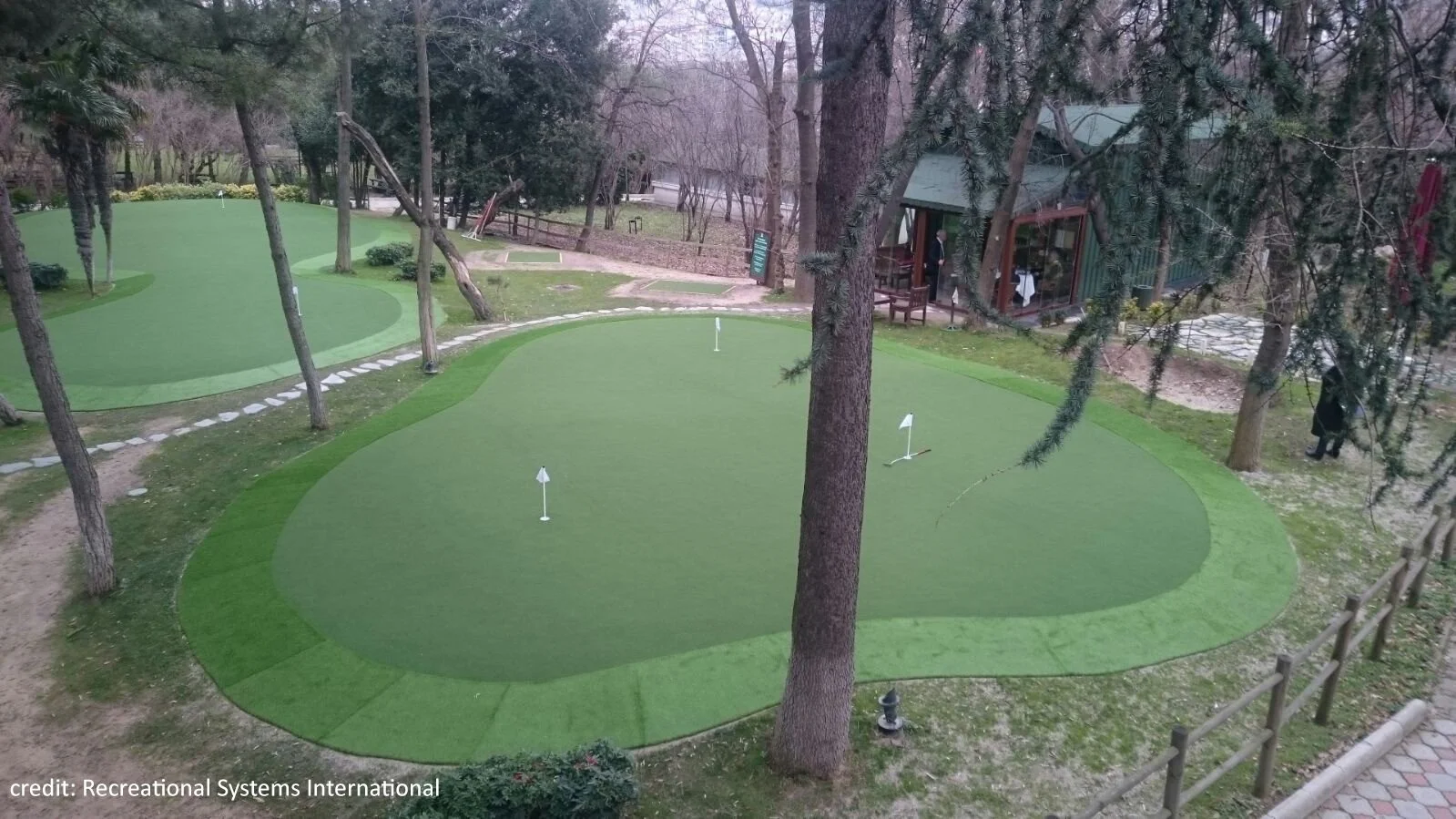
However, for tees and practice putting greens, and in areas where water is expensive or shade or wear is a constant problem, artificial turf can be a maintenance and water saver as an alternative to turfgrass.
Contact Sustain Golf for more information!
We firmly believe that common sense sustainable design, construction, and maintenance practices are the keys to the long-term outlook for the game of golf. We at Sustain Golf aspire to be on the leading edge of applying sustainability concepts to golf course design and construction.
We would be happy to answer any questions that you might have about sustainable golf course design, maintenance, and construction. Visit us at www.sustaingolf.com or contact us at the following email address for more information: matt@sustaingolf.com.
Up Next:
Step 17: Grassing, Grow-in, Landscaping, and Turf Nursery
References:
Dobie, Frank. Goodbye Poa annua, Hello Bentgrass. GCM Magazine, April 2020. Retrieved from https://www.gcmonline.com/course/environment/news/convert-poa-bentgrass-golf
Braun, Ross C., Aaron J. Patton, Eric Watkins, Paul L. Koch, Nicole P. Anderson, Stacy A. Bonos, Leah A. Brilman. Fine Fescues: A Review of the Species, Their Improvement, Production, Establishment, and Management. Crop Science, May/June 2020. Retrieved from https://acsess.onlinelibrary.wiley.com/doi/full/10.1002/csc2.20122.
Golf Course Superintendents Association of America. (2023). Best Management Practices. Planning Guide & Template. GCSAA Foundation. https://www.gcsaa.org/docs/default-source/environment/bmp-planning-guide_2023_print_final.pdf
Hurdzan, Dr. Michael J. Golf Course Architecture: Design, Construction & Restoration. Chelsea, MI: Sleeping Bear Press, 1996.
The Lawn Institute website. Retrieved from https://www.thelawninstitute.org/pages/education/types-of-grasses-and-species-selection/cool-and-warm-season-grasses/
ThoughtCo. What is ‘Overseeding’ on Golf Courses? Retrieved from https://www.thoughtco.com/what-is-overseeding-on-golf-courses-1560943
The National Turfgrass Evaluation Program (NTEP.org)
Photo Credits: Recreational Systems International, Matthew Schiffer, Google Earth
Peer Review:
Dr. Keith Duff, former UK government wildlife agency Chief Scientist, current Golf Environment Consultant
Rick Elyea, President, Elyea Agronomic Consulting