
Key Points
As discussed in Step 2: The Various Modus Operandi of Golf Course Architects,, the two most common ways to build a golf course are either by having the golf course architect prepare a detailed design and then having general contractors competitively bid to do the work (Design-Bid-Build) -or- having the golf course architect and contractor(s) work together to collaboratively design and build the golf course (Design-Build and Architect-Led Design-Build).
Generally, Design-Build projects are less complex and require less detailed design documentation than Design-Bid-Build projects, often allowing for more in-the-field flexibility.
If the project is to be Design-Bid-Build, bid tender package should be as specific as possible and there are several construction documents that are typically prepared.
It is important to thoroughly vet the contractors who bid on the project before awarding the contract.
With key parts of the professional team in place (consulting agronomist, irrigation consultant, golf course superintendent), the golf course architect is now able to complete their design to a high degree of specificity. While it’s not possible to know everything about the site until construction actually begins, there should now be enough information available to confidently finalize plans, specifications, a tentative schedule, and a bill of quantities, whether the job is to be bid upon by general contractors or, in the case of a design-build project, for hiring specialized subcontractors and preparing a realistic budget.
A full set of construction documents for a golf course often includes:
Staking and Layout Plan
Clearing and Demolition Plan
Finish Grading Plan
Earthwork Cut & Fill Plan
Drainage Plan
Grassing Plan
Landscaping Plan
Cart Path and Bridge Plan
Irrigation Design Brief -or- Irrigation Design and Details
Bill of Quantities
Construction Specifications
Typical Construction Details
Green and Bunker Details (either conceptual or showing additional grading and drainage detail)
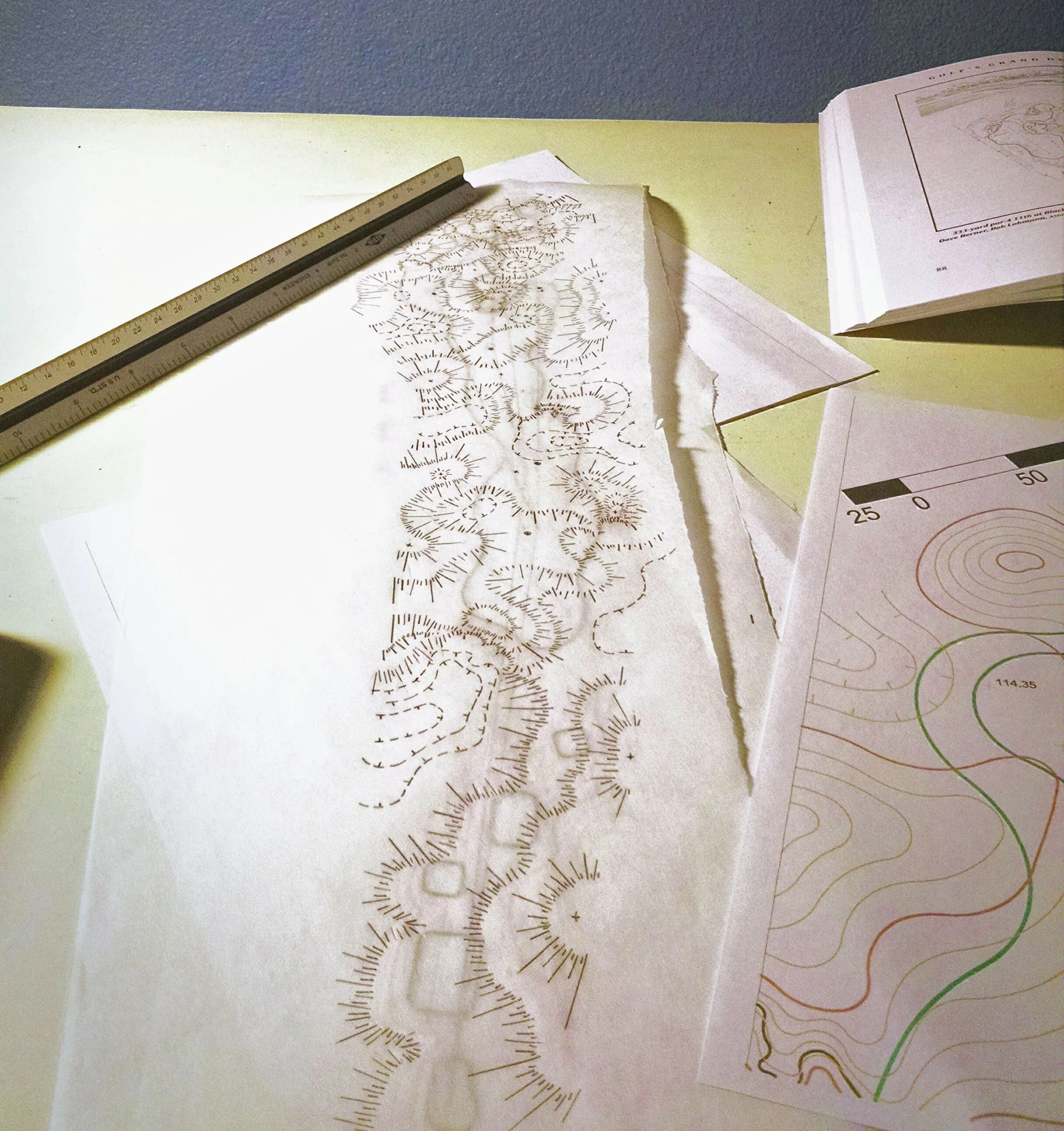
More Specific Versus Less Specific Design Documentation
Design-Bid-Build projects are still the most common and will generally require much more detailed plans and specifications than Design-Build projects. One reason for this is that, wherever there is ambiguity, the qualified** general contractors who bid the job can be incentivized to overestimate the work and inflate the price to be sure that they don’t lose money due to unforeseen circumstances.
(** It’s not uncommon for there to be one or two bids much lower than the rough estimate prepared by the golf course architect. These contractors may be hoping to win the job based on an unrealistically low bid and make up the budget shortfall with change orders, which are also more possible when the plans and specifications aren’t detailed enough. These low-bid contractors will ideally be weeded out during the bid review process detailed below.)
Secondly, without clear instructions, misunderstandings and misinterpretations can arise during construction that can potentially lead to costly mistakes and delays. Without detailed documentation, financial responsibility for these errors can potentially be attributed to the golf course architect. Finally, bonding companies will often not bond projects that are not supported by detailed plans and specifications; nor will institutional lenders typically fund such work.
For Design-Build projects, however, a somewhat less detailed set of design documents is preferable to leave room for creativity and improvisation in the field. The golf course architect will likely need to prepare clearing, bulk earthwork, and storm drainage designs to be subcontracted to specialized contractors who are hired by the client (by bid tender or, often, not). The golf course architect’s team will retain the responsibility for the rough and fine shaping of the golf features (tees, fairways, bunkers, greens) and will have the client purchase materials as needed for these works. The golf course architect will coordinate between all of the various construction personnel and answer to the client’s site representative, who will approve progress payments as work is completed.
This method of construction effectively moves coordination, budgeting, and scheduling responsibilities away from a general contractor and onto the golf course architect. However, the success of a design-build model is reliant upon the shapers buying-in to the golf course architect’s design vision and being talented enough to execute it consistently.
There may not be any “right” answers when the plans are less detailed but there definitely are a world of “wrong” answers if the wrong general contractor gets hired or the design-build team isn’t on the same page or up to the challenge. See Step 2: The Various Modus Operandi of Golf Course Architects for more information about the distinction between the most common construction methods.
It’s also important to note that, no matter who coordinates and executes the construction, the best finished product will always have allowed for some flexibility and on-site discovery. Even exceedingly detailed plans and specifications cannot anticipate all of the issues and opportunities that will be encountered on the site and the golf course architect must be present and willing to make changes to their design in the field (within the constraints of the client’s budget and schedule) to deliver the best results possible.
Ultimately, we at Sustain Golf believe that it is best for everyone involved to be thoroughly informed and prepared before construction begins and that this will give us the flexibility to take advantage of any opportunities and to mitigate many of the unforeseen problems that inevitably arise.
The Bid Tender Process
In the case of a job that will be coordinated and built by a general contractor, the typical steps of the tender process are as follows:
Research qualified contractors;
Invite contractors to bid on the job (private funding) -or- publish a notice to bidders (public funding);
Arrange for a mandatory pre-bid meeting at the site. During this meeting, the golf course architect and their design team will conduct a tour of the property and answer all questions;
Golf course architect and/or specialized consultants issue addenda or clarifications to all bidders as necessary;
Collect bids;
Review of bidders’ submissions (see details below);
Final review of bids with client or client’s bid committee;
Select contractor;
Bid acceptance;
Maintenance bond provided by contractor, guaranteeing labor and material, typically for one year;
Initial payment.
It is incumbent on the golf course architect and the client to do their due diligence before awarding the contract. What follows are criteria that must be investigated (beyond the dollar amount of the submitted bids) prior to awarding the contract:
Contractor’s work references from the past 10-years, including clients and golf course architects;
The budget and schedule track record of the contractor, as confirmed by his references;
The quality and durability of the contractor’s work, as confirmed by his references;
Evidence of repeat clients;
The contractor’s proposed construction monitoring process, including CVs of key team members that will be working on this project;
The contractor’s proposed construction schedule based on the client’s start date and desired opening date;
Will the contractor be hiring subcontractors? If yes, references for the subcontractors;
The contractor’s equipment list;
Proposed construction methods, from mobilization to handoff;
The contractor’s proposed division of contract, which is what the contractor will use to request payments as segments of the job become partially and fully completed.
Realizing the Best and Most Sustainable Golf Course
Even the most detailed planning is only a rough draft of what will ultimately be built. During planning, the golf course architect is building the framework (budget, schedule, strategy, maintenance expectations) within which the final golf course will fit. However, they must also leave room to take advantage of opportunities and creativity that can only be realized once construction has begun. A lack of preparation can lead to expensive and time-consuming mistakes, but over-preparing and inflexibly (or simply turning the plans and specifications over to a general contractor and hoping for the best) is a recipe for missed opportunities and a mediocre golf course.
Achieving the most sustainable golf course is also a mixture of preparation and improvisation. For example, a thorough site investigation is a worthwhile expense and it may identify an opportunity, e.g. to use a material found on site, rather than having to purchase and import it. However, golf courses are built over large areas and, if something wasn’t found during the planning and investigation process, the design and construction team will need to be flexible enough to take advantage of any new discoveries.
Economic, ecological, and community sustainability opportunities will only present themselves to the golf course architect who is open-minded and available enough to identify and take advantage of them.
Contact Sustain Golf for more information!
We have the construction and design experience that is needed to prepare detailed construction documents and to guide our clients through the bid tender process. Based on our plans, specifications, and take-offs, our clients will have a reasonably good idea, before ground has been broken, of how much the work should cost and how long it should take. We will spend every day for the duration of the project on-site and/or coordinating with all contractors, subcontractors, and professional consultants to be sure that no opportunities are lost and that the best golf course for your property is realized.
Up Next:
Step 6: Environmental Planning Principles, Routing the Golf Course, Surveying, Site Preparation, and Clearing
References:
Hurdzen, Dr. Michael J. Golf Course Architecture: Design, Construction & Restoration. Chelsea, MI: Sleeping Bear Press, 1996.
Peer Review:
Excerpts from an essay by Schiffer, Matthew & Cutten, Keith, (2019). Compare and Contrast: Design-Build vs Contractor Model of Golf Course Construction
Dr. Keith Duff, former UK government wildlife agency Chief Scientist, current Golf Environment Consultant