
Key Points
When considering the feasibility of a new golf course, it is vital to understand the quantity and quality of the water that is, and will be, reliably available.
Golf courses around the world utilize diverse, often multiple, water sources for irrigation, with sources typically chosen to manage costs and limit environmental impact. Primary irrigation water sources include groundwater (wells), surface water (lakes, ponds, rivers, canals), and where available, recycled wastewater (effluent) (currently estimated to be used on 12 to 13% of all US golf courses). In some regions, desalinated water and captured stormwater are the primary water sources, while potable municipal water should only be considered when other sources are unavailable or to supplement the supply.
Modern irrigation systems are very flexible and complex so hiring an experienced irrigation design consultant early in the design process will help ensure that the irrigation system is properly designed for maximum efficiency and for the specific requirements of the golf course.
In many parts of the world, water will be one of the golf course’s greatest fixed costs. A thoughtfully-designed irrigation system can pay for itself in added water and electricity efficiencies.
The Golf Course Superintendent Association of America’s (GCSAA) has identified irrigation Best Management Practices (BMPs) that should be incorporated into the irrigation system design to the greatest extent possible to better conserve and protect water resources.
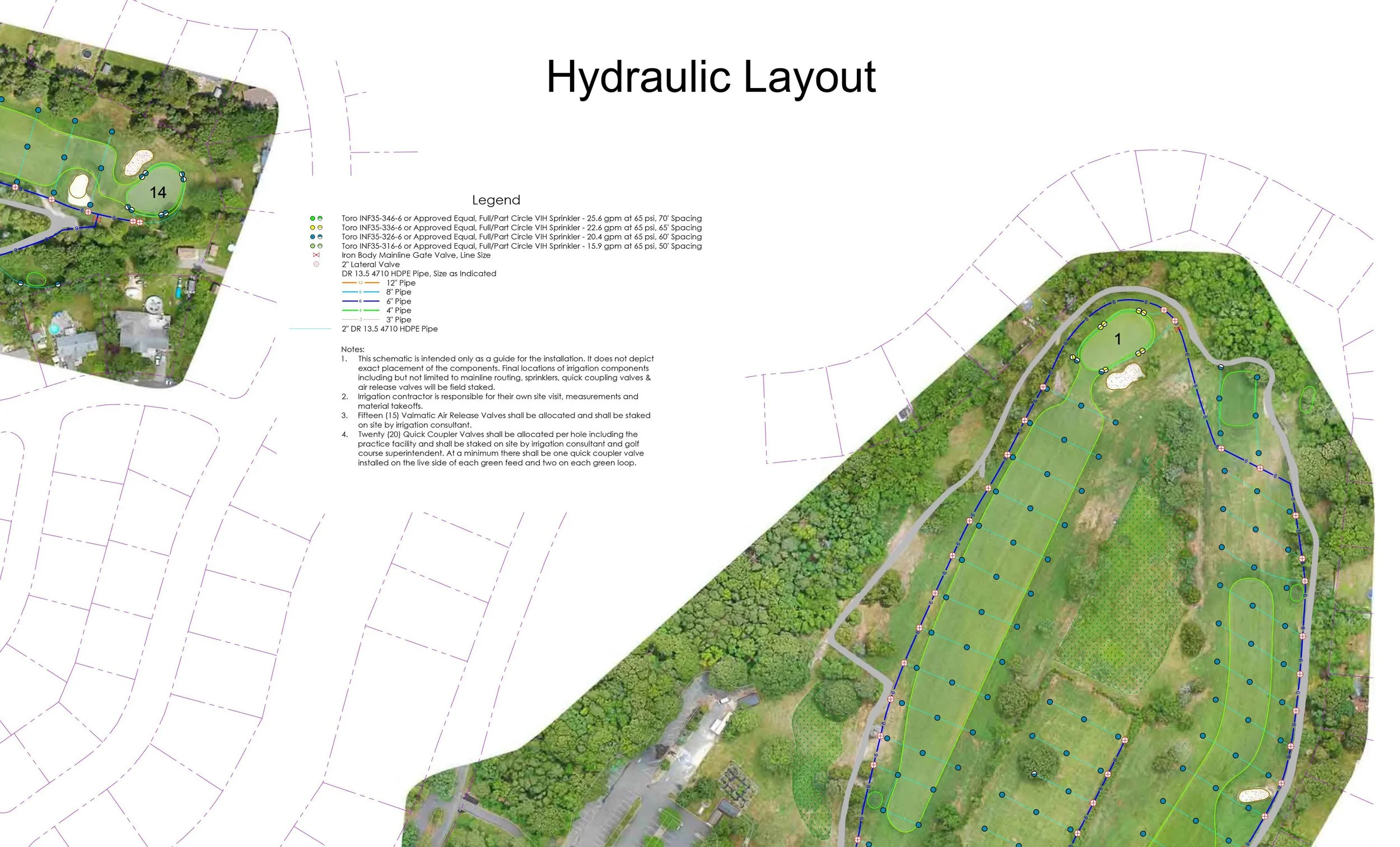
An example of an irrigation system design prepared by an irrigation design consultant.
In most parts of the world supplemental irrigation on the golf course (beyond precipitation) is essential to supporting healthy turfgrass and landscape plant health. Therefore, the availability of water is usually one of the most important considerations when planning a new golf course. Most projects are not “real” before a feasibility study has been conducted to identify the source, quality, and quantity of the water that is available to be used for irrigation. Federal, state, and local water use authorities must be contacted to determine annual or specific water consumption permitting guidelines (water allocation rights), and any other regulatory requirements that will apply to the golf course. Once the quantity of available water from all sources has been determined and confirmed, the golf course architect can begin to design the golf course and define a realistic area of maintained turf to be irrigated.
The irrigation design consultant is normally hired by the owner early in the design stage and will work alongside the golf course architect to design and oversee the installation of an irrigation system that will deliver water to the maintained turf and landscaping as efficiently as possible.
Specific responsibilities of the irrigation design consultant typically include:
Working closely with the owner and the golf course architect in an iterative process to match resources, desired playability, and anticipated irrigation management to define the best irrigation solution for the desired long-term outcome;
Determining the storage requirement for an irrigation pond or ponds;
Providing a detailed irrigation system design, including the sizes and locations of the pumps, pipes, wiring, satellites (if a satellite, rather than decoder, system), and sprinkler heads;
Impartially recommending the best irrigation system manufacturer and type (satellite versus decoder) for the golf course;
Providing a detailed narrative of the reasoning behind the system design and the optimal way to use the irrigation system for future superintendents;
Providing detailed specifications and a bill of quantities so that contractors can bid on the installation of the irrigation system;
Evaluating bids and advising on the selection of the irrigation installation contractor;
Staking the irrigation system and making adjustments based on field conditions and value engineering;
Overseeing the installation of the irrigation system by the irrigation installation contractor;
Providing or approving an as-built of the installed irrigation system;
Punch-list, final approval, and hand-off of the installed irrigation system.
See Step 10: The Design and Installation of the Irrigation System for more information about irrigation system design and installation.
Coordination between the Golf Course Architect, the Consulting Agronomist, and the Irrigation Design Consultant
As discussed in Step 3: The Importance of a Consulting Agronomist, it is important to assemble an experienced team of professional consultants early in the design process so the planning and design can be as comprehensive and accurate as possible prior to construction. Some elements of the irrigation system can have very long lead times, so anything overlooked during the design phase can potentially lead to added cost and scheduling delays down the road. Much like with the consulting agronomist, it is very helpful if the irrigation design consultant has previously worked in the geographic area of the golf course and is familiar with local supply chains and climatic conditions.
Once the golf course architect has completed a preliminary design, the irrigation design consultant can evaluate the proposed turf areas against the quantity of the available water supply and, if necessary, help the golf course architect to value engineer the golf course design to lower irrigation system costs without loss of performance, function, or efficiency. Assuming there’s an adequate supply of water, today’s state-of-the art irrigation systems provide the flexibility to efficiently irrigate just about anything the golf course architect and consulting agronomist can imagine.
Based on the quality of the water and the growing medium (and also on the design brief from the owner), the golf course architect and consulting agronomist will choose turf varieties the are optimized for the local climate and a myriad of desired physical characteristics (e.g. color, height of cut, cool season, warm season, drought tolerant, salt tolerant, heat tolerant, etc.). The irrigation design consultant can then customize the irrigation system design, layout, and programming based on the final golf course design and turf selections.
Ultimately, the irrigation design consultant, the consulting agronomist, and the golf course architect must work together to achieve the owner’s vision for the golf course’s playing characteristics (e.g. emphasizing ground game or aerial game), how the course will look (e.g. the width of the playing corridors, hard edges vs more naturalized edges), and how and to what level the golf course will be maintained.
The Sustainable Use of Water and Electricity
Water is a constant input for almost every golf course and, in areas where water is scarce, it can be one of the largest ongoing maintenance expenditures. Golf courses around the world utilize diverse, often multiple, water sources for irrigation, with the source(s) of the water largely dependent on the location of the course in relation to local and regional water supplies. Regardless of the source(s), the golf course will only be feasible and sustainable if the cost and environmental impact of using the water is manageable over the long term.
Primary irrigation water sources include groundwater (wells), surface water (lakes, ponds, rivers, canals), and where available, recycled wastewater (effluent) (currently estimated to be used on 12 to 13% of all US golf courses**). In some regions, desalinated water and captured stormwater are the primary water sources, while potable municipal water should only be considered when other sources are unavailable or to supplement the supply.
While new irrigation systems are inherently more efficient than older systems, an experienced irrigation design consultant can find additional efficiencies for both water and electricity in the sizing and layout of the irrigation pumps and heads, resulting in potentially substantial long-term cost savings.
Perhaps the greatest efficiencies can be found when the irrigation design consultant works closely with the day-to-day irrigation manager (most often the golf course superintendent) to ensure that the system is used as it was designed to be operated. Since there is often turnover in the superintendent position, the irrigation design consultant can proactively ensure long-term efficiency by preparing a detailed narrative of the reasoning behind their design decisions and suggestions for optimal operation of the irrigation system.
** Large turf areas, including golf courses, are good locations for irrigating with recycled water. In addition to making good use of a degraded water source, turf serves a vital role in cleansing nutrients and contaminants from the recycled water as it moves through the soil and into the aquifer. Nationwide (in the United States), approximately 13% of golf courses use recycled water for irrigation. More facilities would gladly convert to using recycled water, but the main limitation is the lack of a piping system to deliver the recycled water to golf courses, which can cost $1 million per mile or more to install. Despite the expense, many communities recognize the value of (irrigating with) recycled water and are pursuing plans to expand delivery to golf courses and large landscape customers in the future.
Design Using Best Management Practices (BMPs)
In 2023, the Golf Course Superintendents Association of America (GCSAA) issued a BMP Planning Guide and Template in part to help superintendents manage golf facilities in an efficient and environmentally sensitive manner while also providing quality playing surfaces. The BMPs can enable a golf course facility to operate where regulatory pressures exist, and they offer the industry a significant platform for advocacy, education, recognition, and the demonstration of professional land management. It is incumbent upon all professionals in the golf industry to familiarize themselves with the relevant BMPs and apply them where applicable.
The benefits of adopting the GCSAA irrigation BMPs are:
Conserving the water supply
Protecting (or enhancing) existing water quality
Maintaining optimal playing conditions
Saving water and electricity
Increasing pump and equipment longevity
Demonstrating responsible environmental stewardship
See Step 10: The Design and Installation of the Irrigation System for a more detailed discussion about irrigation system design and installation.
Contact Sustain Golf for more information!
We firmly believe that common sense sustainable design, construction, and maintenance practices are the keys to the long-term outlook for the game of golf. We at Sustain Golf aspire to be on the leading edge of applying sustainability concepts to golf course design and construction.
We would be happy to answer any questions that you might have about sustainable golf course design, maintenance, and construction. Visit us at www.sustaingolf.com or contact us at the following email address for more information: matt@sustaingolf.com.
Up Next:
Step 5: Design Documentation and the Bid Tender Process
References:
Plan Credit: Paul Granger, Aqua Agronomic Solutions, Inc.
Golf Course Superintendents Association of America. (2023). Best Management Practices. Planning Guide & Template. GCSAA Foundation. https://www.gcsaa.org/docs/default-source/environment/bmp-planning-guide_2023_print_final.pdf
USGA. (2014, May 20). Shouldn’t every golf course be using recycled water? United States Golf Association. https://www.usga.org/course-care/water-resource-center/our-experts-explain--water/should-every-golf-course-be-using-recycled-water-.html
USGA. (2016, April 11). Getting water for your course. United States Golf Association. https://www.usga.org/content/usga/home-page/course-care/water-resource-center/getting-water-for-your-course.html
Peer Review:
Don Mahaffey, President, Greenscape Methods LLC
Dr. Keith Duff, former UK government wildlife agency Chief Scientist, current Golf Environment Consultant