
Step 1: The Sustainability Benefits of Hiring a Qualified Golf Course Architect
Key Points
There are many advantages to hiring a qualified and experienced golf course architect, chiefly that an experienced professional has the breadth and depth of experience to design a project with a better view of the big picture and its long-term impacts.
The right golf course architect will have a broad perspective and will work together with the golf course superintendent to integrate sustainable maintenance practices in the development, maintenance, and operation of the course.
By definition, a “proper design” will meet the needs of the stakeholders, protect the location’s environmental resources, and be economically sustainable.
Even if the up-front cost is higher, in most cases, utilizing an experienced contractor rather than in-house labor will also result in a better and more sustainable outcome.
When the leadership of a golf club decides to undertake a golf course renovation, whether major or minor, there is often the temptation to design and execute the work in-house, theoretically saving the time and money of finding and hiring a qualified golf course architect. While keeping everything in-house may make sense under certain circumstances, this article will examine the advantages of outsourcing the design and construction to experienced and qualified professionals, including improved sustainability.
Why Hire a Golf Course Architect?
Golf course superintendents are trained and focused on the maintenance of golf courses. When asked to design and build an improvement to the golf course that they will need to maintain, the natural inclination may be for the superintendent to view that improvement primarily from the perspective of ease of maintenance or improved agronomy. Golf course architects, on the other hand, are trained to view golf courses more holistically and can analyze a project in the context of strategy for the revised hole(s), how well the improvement will fit in with the remainder of the golf course, shot values for players of all skill levels and swing speeds, historical context, aesthetics, costs/benefits, and safety.
An experienced golf course architect will also have a better understanding of ball flight and shot dispersion, and will therefore be better able to locate golf features relative to each other and to out-of-play areas to mitigate risk. For example, if a golf course committee is interested in moving or adding a tee, an experienced and qualified golf course architect will consider not only the potential agronomic and maintenance issues of the new tee but also safety, accessibility, strategy, visibility, and playability for all classes of players.
The renovation project can be even more cohesive if the architect is given the opportunity to prepare a long-range master plan for the entire golf course – laying out a long-term vision of ordered and prioritized improvements. This type of big-picture planning can help determine whether the project that the club is currently considering is the highest priority or whether limited resources should instead be devoted to another project that is more urgent. The worst-case scenario is when money is spent on a project that will become obsolete in a short time because it was done out of order or not actually needed.
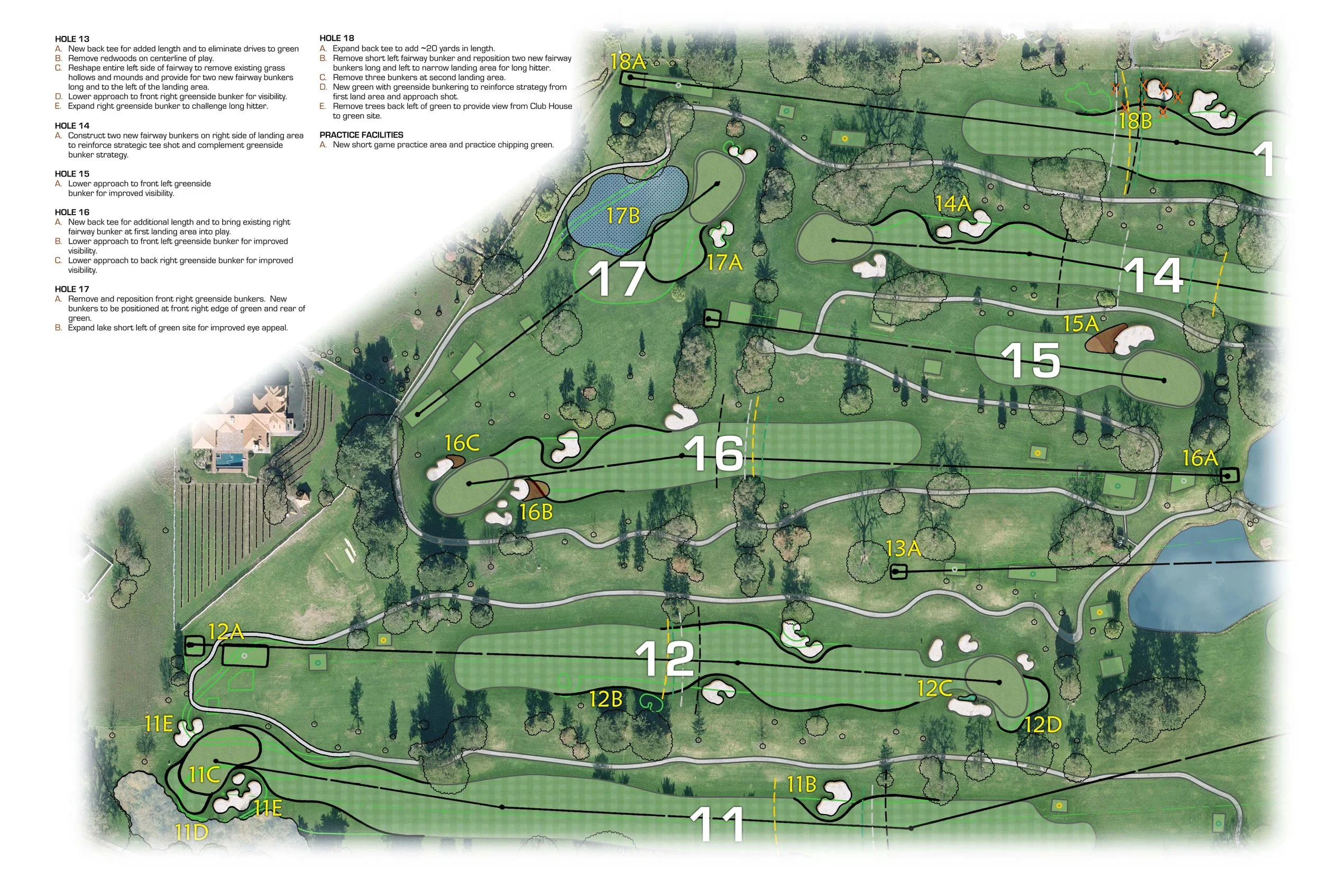
An example of a long-range master plan.
When the leadership and membership of a club has determined that they want to make a change to their golf course, they would be wise to interview several qualified golf course architects because there may be more than one way to approach the issue. Different golf course architects have different experiences and perspectives, so the selection committee will want to find the architect that best matches their priorities and vision. “Qualified” can seem subjective, but it goes without saying that professionals with ample experience and success on projects with similar scopes plus strong references should be given the first consideration. Golf course architects who belong to industry-specific professional organizations such as the American Society of Golf Course Architects (ASGCA), the European Institute of Golf Course Architects (EIGCA), or the Society of Australian Golf Course Architects (SAGCA) can be considered to have been pre-vetted by those organizations.
Hiring a golf course architect will not only move responsibility for the project away from the superintendent, it will also alleviate the responsibility and liability for potentially complex design decisions from all golf course stakeholders and decision makers (greens committee, membership, club president, general manager, municipal administrators and politicians, etc.) without diminishing their roles as the final decision makers. Whereas a project conceived by the greens committee and undertaken by the golf course superintendent and maintenance staff could leave all parties open to criticism and liability, the golf course architect, as an outside consultant, will be working hard to build consensus among the diverse set of stakeholders until an agreeable design solution is reached that appeals to the majority.
This isn’t to say that the golf course superintendent should not be heavily involved throughout the process. The superintendent knows and understands the golf course intimately and will have a broad and thorough understanding of its agronomic and maintenance issues. Plus, the superintendent will be responsible for maintaining the improvements once they are built, so their input and buy-in are vital to the long-term success of the project. It is therefore imperative that the superintendent and golf course architect work hand-in-hand to satisfy the goals and expectations of the membership and ownership.
In terms of relative costs, the golf course architect is often able to translate their experience into cost effective and/or economically sustainable solutions that the golf course superintendent may not be attuned to. This can happen through value engineering (defined as finding a way to provide the same function for a lower cost) or coordinating with trusted industry contacts including contractors, shapers, agronomists, and irrigation specialists to find additional efficiencies.
A final reason to hire a golf course architect is that they are very likely to have a broader base of design experience than the golf course superintendent, enabling a quicker recognition of solutions that have been applied to similar problems on previous jobs. Ideally, the golf course architect will also be familiar with sustainable design and construction best practices, leading to a smaller environmental impact, greater community accessibility and buy-in, long-term economic benefits, or ideally all three.
For larger renovation projects, an early partnership with the Golf Environment Organization (GEO) Foundation might also make sense. The GEO Foundation has a wealth of resources and experience in helping golf courses achieve and quantify greater sustainability and will work with the golf course architect and golf course superintendent to achieve the most sustainable design solution and construction strategy. When the project is complete, the GEO Foundation will also help to promote and celebrate these positive outcomes. The GEO Foundation is uniquely positioned to provide guidance and quantifiably measure the improvements resulting from greater sustainability in the day-to-day management and operation of the golf course.
In-House Labor or an Outside Contractor?
Once the design of the renovation project is under the direction of a qualified golf course architect, there are arguments to be made for using maintenance staff to carry out elements of the project. Perhaps parts of the golf course will need to be closed and, as a result, the maintenance staff will need to be kept busy in the interim. Perhaps the maintenance staff already has the proper equipment and a good amount of experience and competence to handle portions of the project, making the sourcing of outside labor unnecessary.
However, it is also important to consider the risks of giving the maintenance staff more than they are ready to handle. If the project is prominent and/or disruptive enough, the membership will demand that it be completed as quickly as possible. Needless to say, re-work, budget, and schedule overruns will not be tolerated, especially if they could have been avoided by outsourcing to a qualified professional contractor to begin with. With the exception of the most tailor-made remodeling projects, it’s safe to say that a few dollars saved today by using in-house staff are not worth the long-term risk of using an inexperienced or ill-equipped labor force. This isn’t even to mention the attention that has been diverted from the day-to-day maintenance of the remainder of the golf course while the maintenance staff is engaged with the remodeling project.
Finally, there is a third option for very small projects. The golf course architect can sometimes bring in his or her own shaper and utilize a limited number of in-house staff while overseeing and coordinating the construction themselves. This would eliminate the need for a formal bid process to select a qualified contractor. This would also give the architect the opportunity to make inexpensive field adjustments to improve the project “on the fly” based on field conditions. The trade-off is that the golf club will need to appoint a knowledgeable representative who has been empowered to make decisions to oversee the work (to, among other things, serve as a liaison between the golf course architect and the other stakeholders, purchase materials, and inspect and approve the construction). This methodology will be discussed in greater detail in the next article - Step 2 - The Various Modus Operandi of Golf Course Architects.
We at Sustain Golf believe that common sense sustainable design and construction practices will enrich the health of the natural landscape while also fostering broader support for the project within the local and regional community and, over the long-term, making the project more economically viable. Within this series of articles, we aim to highlight sustainable practices that can have long-term environmental, social, and economic benefits with relatively low capital outlay.
Contact Sustain Golf for more information!
We firmly believe that common sense sustainable design, construction, and maintenance practices are the keys to the long-term outlook for the game of golf. We at Sustain Golf aspire to be on the leading edge of applying sustainability concepts to golf course design and construction.
We would be happy to answer any questions that you might have about sustainable golf course design, maintenance, and construction. Visit us at www.sustaingolf.com or contact us at the following email address for more information: matt@sustaingolf.com.
Up Next:
Step 2 – The Various Modus Operandi of Golf Course Architects
Sustain Golf is a sustainability- and accessibility-focused golf course design company. We have the breadth and diversity of experience and knowledge to offer a full suite of golf course design, construction, and consultation services, from first concept to opening day and into operations on your new or remodeled golf course.
References:
ASGCA Insight (2016, Spring). The Wise Decision. Retrieved from http://asgca.org/images/stories/by-design/2016/Issue_27/The_wise_decision.pdf
Hurdzan, Dr. Michael J. In-House Vs. Out-Source. Retrieved from https://asgca.org/design/existing-courses/course-renovation-articles/in-house-vs-out-source/
GEO website. Retrieved from https://sustainable.golf/
Golf Course Superintendents Association of America. (2023). Best Management Practices. Planning Guide & Template. GCSAA Foundation. https://www.gcsaa.org/docs/default-source/environment/bmp-planning-guide_2023_print_final.pdf
Pavalko, R. Scott, (2016, Sept). Ground Control: Navigating a Renovation. Retrieved from https://www.gcmonline.com/news/ground-control-navigating-a-renovation
Peer Review:
Dr. Keith Duff, former UK government wildlife agency Chief Scientist, current Golf Environment Consultant