
Key Points
Bulk earthwork begins after clearing and the stockpiling of topsoil and is done simultaneously with the installation of storm drainage.
Bulk earthwork is the process of using large machinery to move large quantities of earth from areas of “cut” to areas of “fill”.
It is most efficient, cost-effective, and environmentally sensitive to minimize bulk earthwork to the greatest extent possible. When bulk earthwork must be done (e.g. to build an irrigation supply pond), the haul distances should be minimized and cuts and fills should balance. Paying to import or export material should be avoided whenever possible.
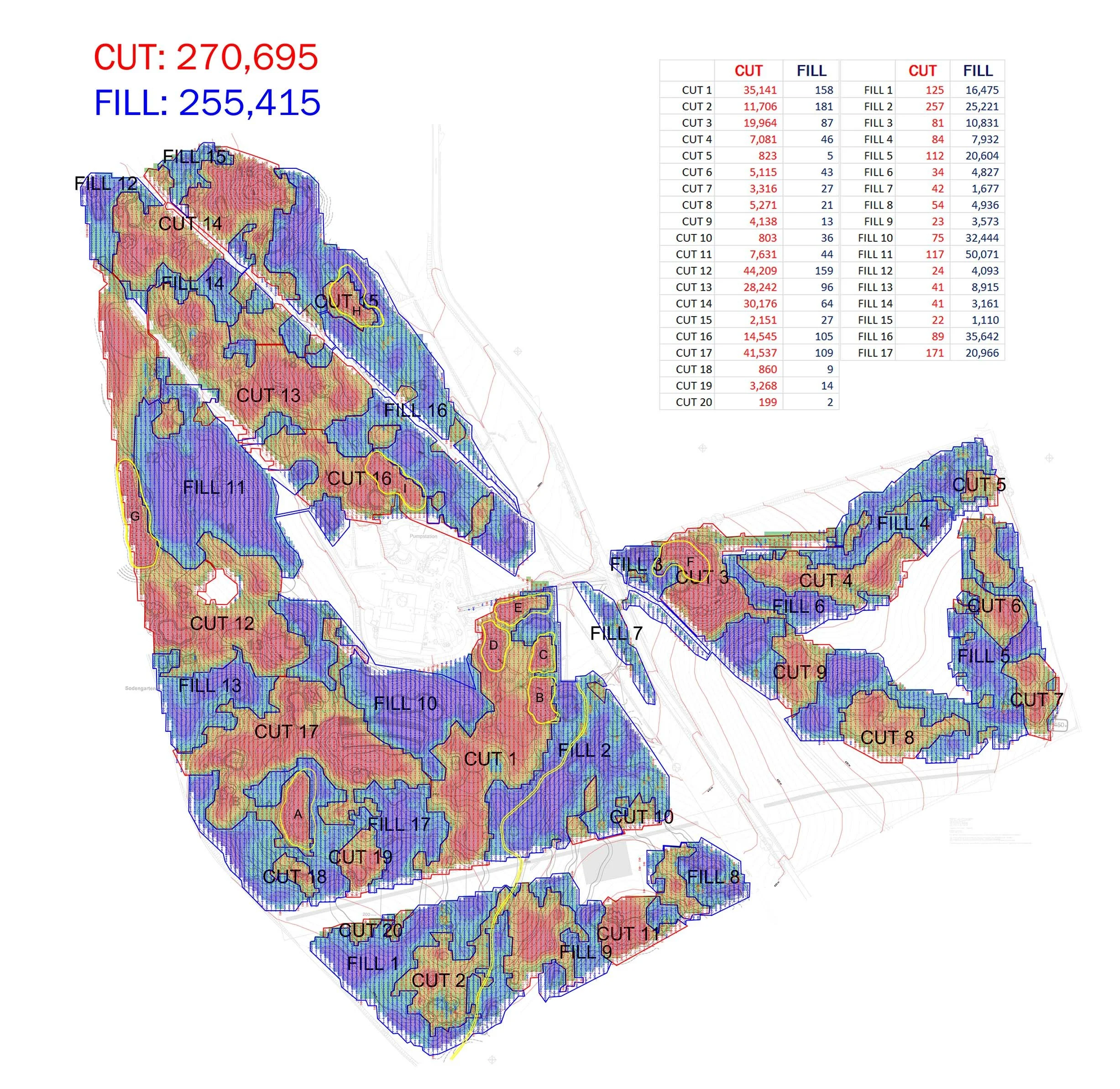
An example of a Cut & Fill plan
With the completion of clearing and grubbing, two separate operations can now begin in earnest and simultaneously – bulk earthwork and the installation of storm drainage. Storm drainage will be discussed in detail in Step 8: Drainage Layout and Installation & and Overview of SuDS.
All environmentally sensitive areas and native vegetation to be saved will have been surveyed during the clearing phase and these areas should be protected by fencing before the construction begins in earnest. The machine operators should be fully and regularly briefed on where these sensitive areas are and how to work around them. If it’s absolutely necessary to work near or within an environmentally sensitive area, it would be wise to hire an environmental consultant during the design phase to determine the particular requirements for these areas (e.g. the timing of breeding season for an endangered animal) to come up with practices and procedures to alleviate the effects of nearby construction activity, and to supervise construction activities once they have begun within or near these areas.
When the schedule for bulk earthwork has been solidified, it is also a good idea to notify the local community (particularly in a densely populated area) so the neighbors aren’t surprised and to give them a chance to reschedule or rethink activities that might be impacted by the dust and noise generated by the trucks and heavy machinery.
On the topic of dust, it is good practice for the contractor to dampen areas that are being worked on. This will minimize the amount of dust that is generated and impacting both on-site and off-site areas.
As discussed in Step 6: Environmental Planning Principles, Routing the Golf Course, Surveying, Site Preparation, and Clearing, prior to the commencement of bulk earthwork, all topsoil will have been removed to a depth recommended by the consulting agronomist and stockpiled for later use.
Bulk earthwork is then carried out by large equipment to move large quantities of material from areas of “cut” to areas of “fill”. Since the advent of modern construction equipment, it has been common practice for the contractor to have their surveyor set out wooden grade stakes to give the machinery operators a sense for how much material to move (cuts) and where to place it (to within two or three feet), i.e. fills. It’s now becoming increasingly common for contractors to use machinery guided by GPS systems (with the golf course architect’s design plugged in) for this task, which can save a significant amount of time and labor placing (and re-placing) easily destroyed wooden stakes. If the golf course architect’s design is sufficiently detailed, GPS-guided bulk earthwork can result in higher accuracy and less re-work in the placement of the material, saving significant fuel, time, and money.
Different Sites Call for Different Construction Methods
A site with sandy soil, gentle topography, and adequate storage capacity for irrigation water may require little to no bulk earthwork, only rough and fine shaping “in-place” to create the golf features (see Step 9: From Rough Shaping to Fine Shaping). Sites that are more challenging - with severe topography, an abundance of rock, or lacking a natural place to store irrigation water - may require a substantial amount of bulk earthwork.
A “typical site” will require at least a little bulk earthwork, perhaps to dig out an irrigation pond. The golf course architect (likely with the help of a civil engineer and/or the irrigation design consultant) will determine how much capacity the irrigation pond must have and how much material will need to be moved to achieve that capacity. The golf course architect will then determine where on the site that excavated material should be placed and properly compacted. Ideally, a balance is achieved between “cuts” and “fills” (so that little to no material needs to be imported or exported) and the haul distance between the removal and placement of the material is minimized to save time and fuel costs.
On a site with a lot of rock, the contractor may have to blast or break the rock in order to achieve the desired grades. Again, the golf course architect will determine where the pulverized material is to be moved and how to best utilize it (e.g. as rock walls) or bury it.
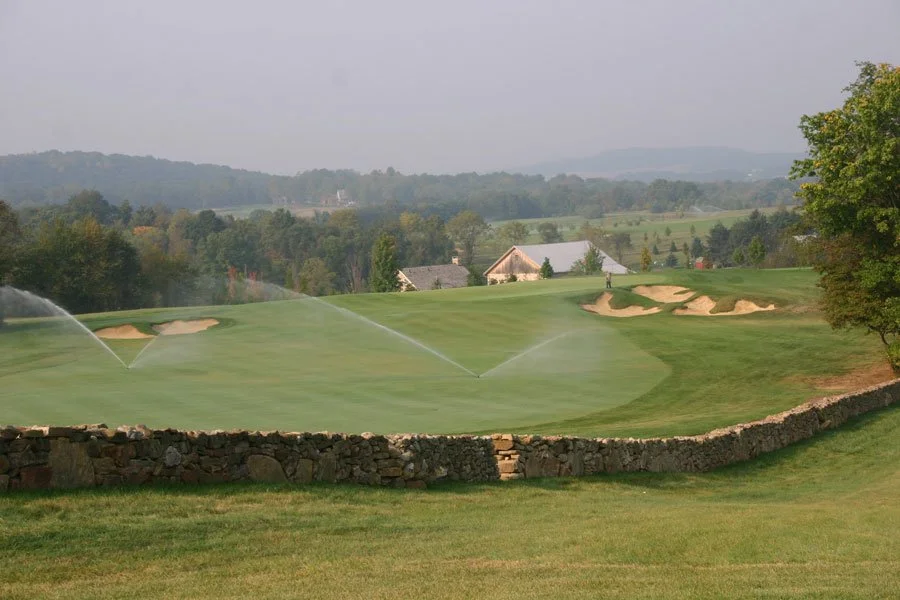
Rocks walls are one way to repurpose rock found on site
Finally, on a site with a high-water table, the soil will need to be “de-watered” before it is moved to its final location for ease of transport. This can be accomplished by dredging, pumping, or using machinery to move the soil to higher ground and letting it dry naturally before moving it again.
Sustainability in Mass Excavation and Earth Moving
Due to the high costs associated with heavy machinery and the collateral damage and disruption to nearby natural areas and neighboring communities, common sense dictates that the most environmentally and economically sustainable method of bulk earthwork is no bulk earthwork at all. However, very few sites in their natural state are perfect for golf, so it’s reasonable to expect at least some bulk earthwork will be necessary to achieve the best possible golf course.
Assuming that bulk earthwork must take place, good sustainable practice dictates that haul distances for the material be minimized to save money, time, and fuel. Also, it is always best to use what’s available on site (e.g. blasted rocks for rock walls) rather than importing materials that are not readily available. Thinking outside the box (and specifications) to use material found on-site can sometimes yield surprisingly good results with a very positive impact on the budget. Finally, in the rare situation where there is unwanted excess fill or debris, as long as it is not hazardous, it is most cost-efficient to keep it on-site (and repurpose it, if possible) rather than exporting it off-site to landfill.
If imported material is deemed absolutely necessary (e.g. there is no on-site sand or gravel for rootzone mix that is up to specification and quality standards), every effort should be made to use material that is sourced locally. This will not only save on transportation costs (monetary and environmental costs such as carbon emissions) but ideally will provide additional benefits to the local economy.
Finally, it bears mentioning that all contractors should ensure that there is no spillage or leakage of fluids from their machinery – from the bult earthwork phase through the end of construction. This is especially important near environmentally sensitive areas. Before construction begins the contractor should have a plan in place should a leak or spill occur.
Contact Sustain Golf for more information!
We firmly believe that common sense sustainable design, construction, and maintenance practices are the keys to the long-term outlook for the game of golf. We at Sustain Golf aspire to be on the leading edge of applying sustainability concepts to golf course design and construction.
We would be happy to answer any questions that you might have about sustainable golf course design, maintenance, and construction. Visit us at www.sustaingolf.com or contact us at the following email address for more information: matt@sustaingolf.com.
Up Next:
Step 8: Storm Drainage Design and Installation & An Overview of SuDS
References:
Hurdzen, Dr. Michael J. Golf Course Architecture: Design, Construction & Restoration. Chelsea, MI: Sleeping Bear Press, 1996.
Photo Credit: Retrieved from https://www.planetgolf.com/courses/usa/stonewall/north-course
Peer Review:
Dr. Keith Duff, former UK government wildlife agency Chief Scientist, current Golf Environment Consultant